
10 Tech Skills AI Cannot Replace in 2026 For Your Career
What if the skills you’re learning today become useless tomorrow? because of AI and automation are reshaping the IT world—but some skills will always stay in demand. Here are 10 tech skills that can secure your future.
03 Apr 2026•5 min read
SEO Content Writer
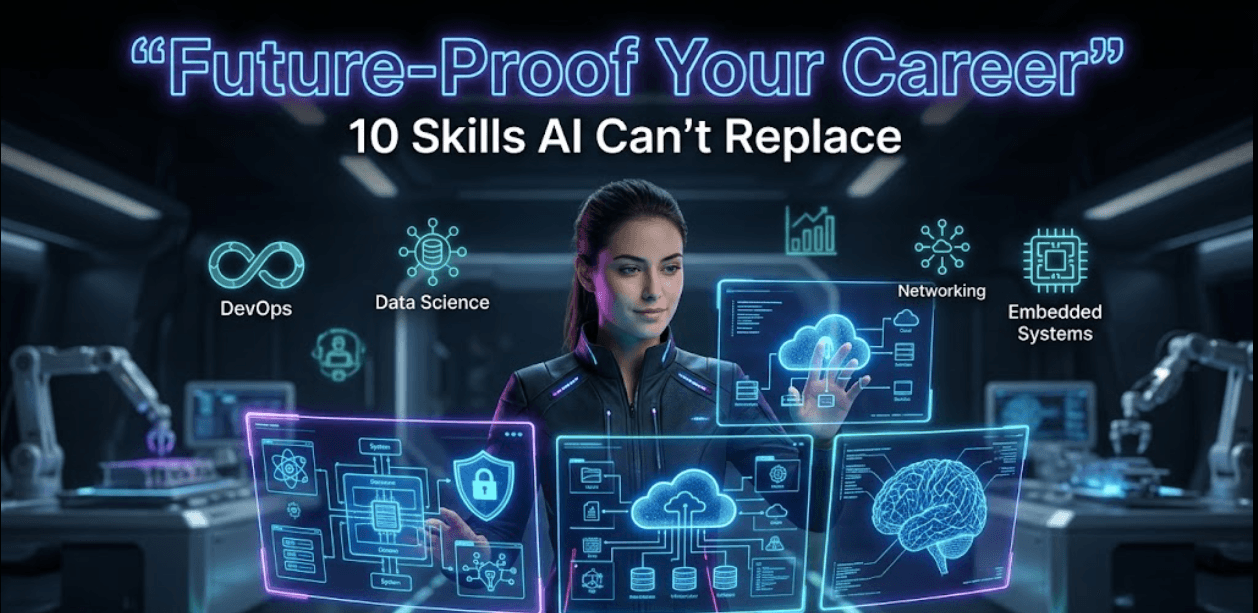
Why These Are the Tech Skills AI Can't Replace?

Human AI connection
Every week, another headline warns about the tech skills AI can't replace — and honestly? It's not entirely wrong. AI tools can already write code, generate SQL queries, debug simple errors, and draft documentation faster than most junior developers. If your entire value rests on doing basic, repetitive coding tasks, that's a quite concerning in this era of AI.
But here's the nuance that most of those headlines hide:
“AI replacing tasks is not the same as AI replacing engineers”
This article isn't about soft skills or emotional intelligence. It's purely about technical, in-demand skills that AI genuinely cannot own end-to-end.
Not because the technology lacks capability in isolated demos, but because production environments and real stakes demand something that currently sits with humans:
Swipe to view all columns →
| What AI Can Do | What Humans Must Own |
|---|---|
| Generate code for isolated problems | Navigate complex, legacy production systems |
| Suggest architecture patterns | Make accountable decisions under pressure |
| Run regressions and surface data | Interpret business context behind the numbers |
| Write a working SQL query | Optimize queries across 500M rows with zero downtime |
| Create interface mockups | Conduct real user research and synthesise feedback |
Here Are The 10 Future-Proof Tech Skills AI Won’t Replace Listed Below⬇︎
1. System Architecture Design
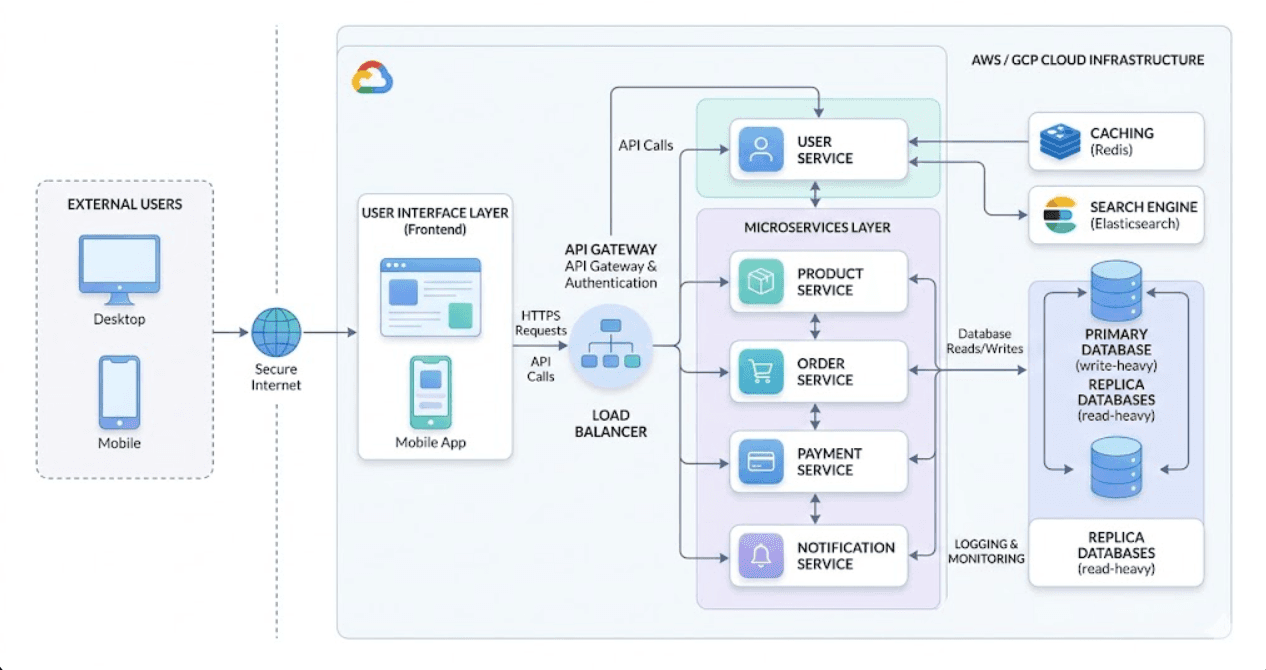
Simple System architecture diagram
If there is a single skill that separates engineers from architects, it is this one. Designing scalable, resilient systems requires a quality that AI fundamentally lacks: the ability to own a decision under real pressure, with incomplete information, and live with the consequences.
When an architect chooses between micro-services and a monolith, they are not just selecting a technical pattern. They are weighing the maturity of the team, the company's growth projections, the cost of cloud infrastructure, and the risk appetite of the business — all at once, all without a perfect dataset to work from. AI can suggest. It cannot decide.
To succeed in this domain, you’ll need:
- Distributed systems and micro-services architecture
- Database selection and schema design
- Cloud infrastructure planning (AWS, Azure, GCP)
- API design and service communication strategies
- Cost-performance-security trade-off analysis
The demand for architects is not shrinking — it is accelerating as more businesses move complex workloads to the cloud and discover that generated code and generated systems are two very different things.
Pay Scale:
Swipe to view all columns →
| Position | Estimated Salary (USD) |
|---|---|
| Entry Level | $70,000-$110,000 |
| Mid Level | $115,000-150,000 |
| Expert Level | $200,000-$350,000 |
2. Cybersecurity Engineering

Cybersecurity attack defense
Cybersecurity is a human vs. human discipline.
With cyber attacks becoming more frequent and costly, professionals who can prevent, detect, and respond to security incidents are in high demand across all industries. But the reason AI cannot replace security engineers runs deeper than frequency.
Attackers are creative, motivated, and constantly evolving their methods. Defending against them requires thinking like they do — which requires human intuition, experience, and contextual reasoning that no model can replicate.
Skills within cybersecurity that remain firmly human-led:
- Penetration testing and ethical hacking
- Security architecture and threat modelling
- Incident response and forensic investigation
- Zero-trust network design
- Compliance and regulatory strategy
Staying up to date with the latest cyber security trends and technologies will be essential in this ever-changing landscape. This is not a field where static knowledge compounds — it is one where continuous learning is the baseline requirement for staying relevant.
Pay Scale:
Swipe to view all columns →
| Position | Estimated Salary (USD) |
|---|---|
| Entry Level | $75,000-$100,000 |
| Mid Level | $120,000-$180,000 |
| Expert Level | $200,000-$400,000 |
3. AI & Machine Learning Engineering

AI Architecture
Here is the irony that most people miss: the skill of building AI is among the skills most resistant to AI replacement.
A growing number of businesses already rely on AI tools to increase their productivity, with even more businesses interested in finding ways to integrate AI into their work stream, business model, products, or services. But someone has to build those tools. Someone has to train the models, curate and clean the datasets, fine-tune systems for specific domains, manage ML pipelines at scale, and evaluate whether a model is actually performing or just appearing to.
Key skills to master:
- Model training and fine-tuning (LLMs, computer vision, NLP)
- Dataset curation, labelling, and pipeline management
- MLOps and model deployment infrastructure
- Model evaluation and performance monitoring
- Deep learning frameworks (PyTorch, TensorFlow)
Pay Scale:
Swipe to view all columns →
| Position | Estimated Salary (USD) |
|---|---|
| Entry Level | $80,000-$120,000 |
| Mid Level | $180,000-$200,000 |
| Expert Level | $250,000-$500,000 |
4. Data Science & Advanced Analytics

Cloud-based pipeline diagram
As businesses increasingly rely on data to make informed decisions, they require employees with the ability to collect, interpret, and share data that can solve their business problems. AI can analyze data. It can run regressions and surface correlations. What it cannot do is understand the context behind the numbers — the business history, the organizational politics, the market dynamics that explain why a metric moved and what to actually do about it.
Data scientists who combine technical precision with strategic thinking are commanding some of the highest salaries in the market.
Critical skills within this domain:
- Statistical analysis and hypothesis testing
- Python, R, and SQL proficiency
- Big data tools (Spark, Hadoop, Databricks)
- Data visualisation (Tableau, Power BI, D3.js)
- Business strategy and stakeholder communication
Pay Scale:
Swipe to view all columns →
| Position | Estimated Salary (USD) |
|---|---|
| Entry Level | $75,000-$100,000 |
| Mid Level | 120,000-$150,000 |
| Expert Level | $150,000-$250,000 |
5. Cloud & DevOps Engineering
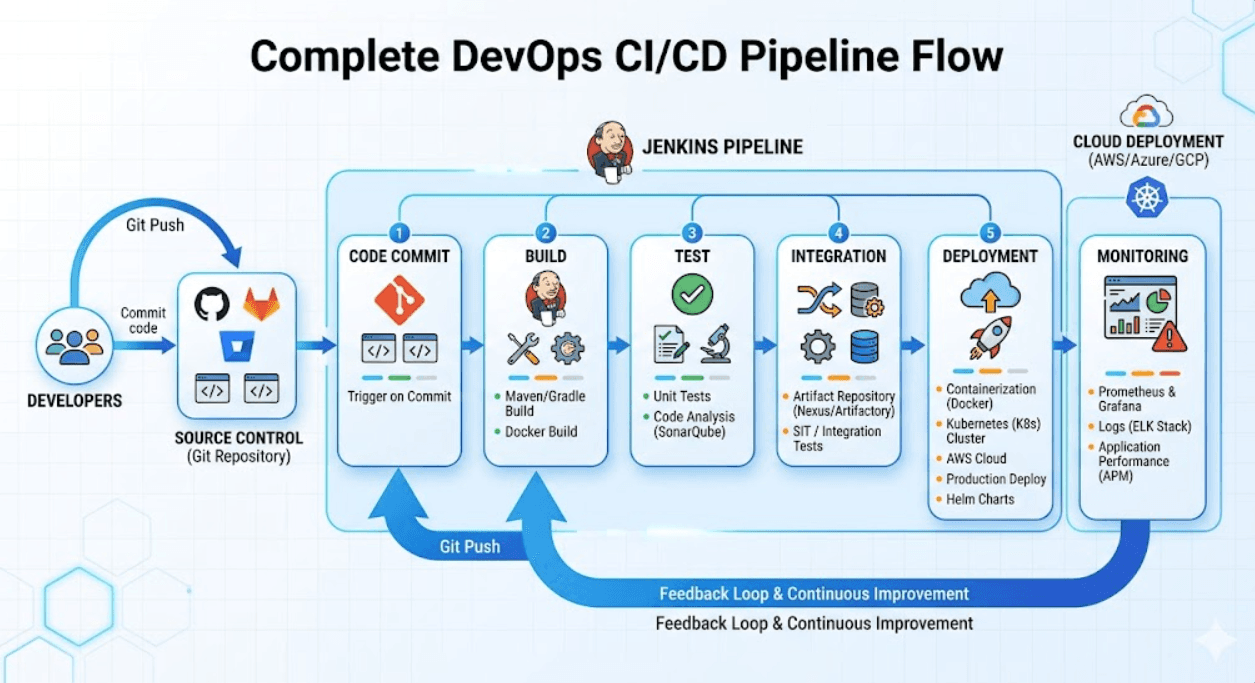
DevOps pipeline diagram
Real infrastructure breaks in unpredictable ways. A deployment pipeline that works flawlessly in staging fails in production because of a single misconfigured environment variable. A Kubernetes cluster starts throwing cryptic errors at midnight. A cost spike appears in the cloud bill and nobody can trace where it came from.
Real systems break in unpredictable ways — humans fix them. DevOps engineering is built around handling exactly this kind of unpredictability, and it demands the kind of contextual, experience-driven judgement that AI tools consistently fall short on.
Core skills to master:
- CI/CD pipeline design and maintenance
- Container orchestration (Kubernetes, Docker)
- Cloud platforms: AWS, Azure, Google Cloud
- Infrastructure as Code (Terraform, Ansible)
- On-call incident response and post-mortem analysis
Pay Scale:
Swipe to view all columns →
| Position | Estimated Salary (USD) |
|---|---|
| Entry Level | $100,000-$115,000 |
| Mid Level | $120,000-$150,000 |
| Expert Level | $150,000-$200,000 |
6. Software Engineering (Advanced Level)

Modern architecture diagram
There is a gap between writing code and engineering software, and AI is exposing it wider every year. AI is increasingly capable at generating code for isolated, well-defined problems. It struggles considerably with the messy reality of production systems.
Senior software engineers who can navigate complex legacy codebases, architect maintainable solutions, and work effectively within large teams are not becoming less valuable — they are becoming rarer, and therefore more valuable. The AI-generated code is, paradoxically, increasing the demand for engineers who truly understand what they are building.
Skills that distinguish skilled engineers:
- Large-scale codebase navigation and refactoring
- Legacy system maintenance and modernisation
- Code review, architecture ownership, and mentorship
- Testing strategy and quality engineering
- Cross-functional technical leadership
Pay Scale:
Swipe to view all columns →
| Position | Estimated Salary (USD) |
|---|---|
| Entry Level | $75,000-$100,000 |
| Mid Level | $120,000-$180,000 |
| Expert Level | $150,000-$200,000 |
7. Database Engineering & Optimisation
Database Architecture diagram
AI can write a SQL query. Writing a SQL query that performs efficiently against 500 million rows in a live production environment with proper indexing, query planning, partitioning strategy, and zero downtime during migration is a different discipline entirely.
Database engineering involves designing efficient schemas, query optimisation, and handling massive datasets. Engineers who understand how query optimisers work under the hood, who can model data for both flexibility and performance, and who can architect data infrastructure that scales remain consistently in demand across every industry vertical.
Key skills required:
- Relational and non-relational database design (PostgreSQL, MongoDB, Cassandra)
- Query optimisation and execution plan analysis
- Data migration and schema evolution strategies
- Sharding, replication, and high-availability configurations
- Data warehouse architecture (Snowflake, BigQuery, Redshift)
Pay Scale:
Swipe to view all columns →
| Position | Estimated Salary (USD) |
|---|---|
| Entry Level | $70,000-$120,000 |
| Mid Level | $120,000-$150,000 |
| Expert Level | $200,000-$250,000 |
8. Embedded Systems & Hardware Programming
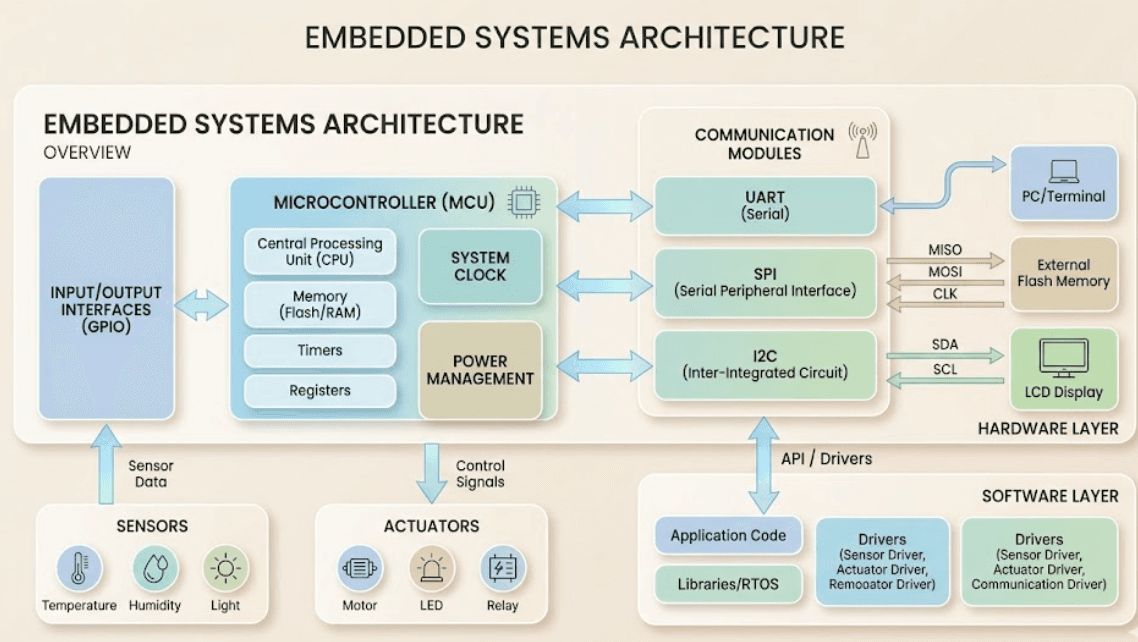
Embedded architecture diagram
AI lives in software. Hardware does not care about prompts.
Embedded systems engineering operates at a layer of the stack that language models simply cannot touch. Writing firmware for an IoT device, debugging a memory overflow on a microcontroller with 4KB of RAM, or optimising a real-time control system for sub-millisecond latency — these tasks require an understanding of the physical world that no model currently possesses.
Areas of embedded engineering with strong demand:
- Microcontroller programming (ARM, AVR, RISC-V)
- IoT device firmware development
- Real-time operating systems (RTOS)
- Hardware-software integration and testing
- Industrial automation and control systems
As the IoT market continues expanding across manufacturing, healthcare, and smart infrastructure, this specialisation is only growing in value.
Pay Scale:
Swipe to view all columns →
| Position | Estimated Salary (USD) |
|---|---|
| Entry Level | $70,000-$120,000 |
| Mid Level | $120,000-$160,000 |
| Expert Level | $200,000-$300,000 |
9. Network Engineering
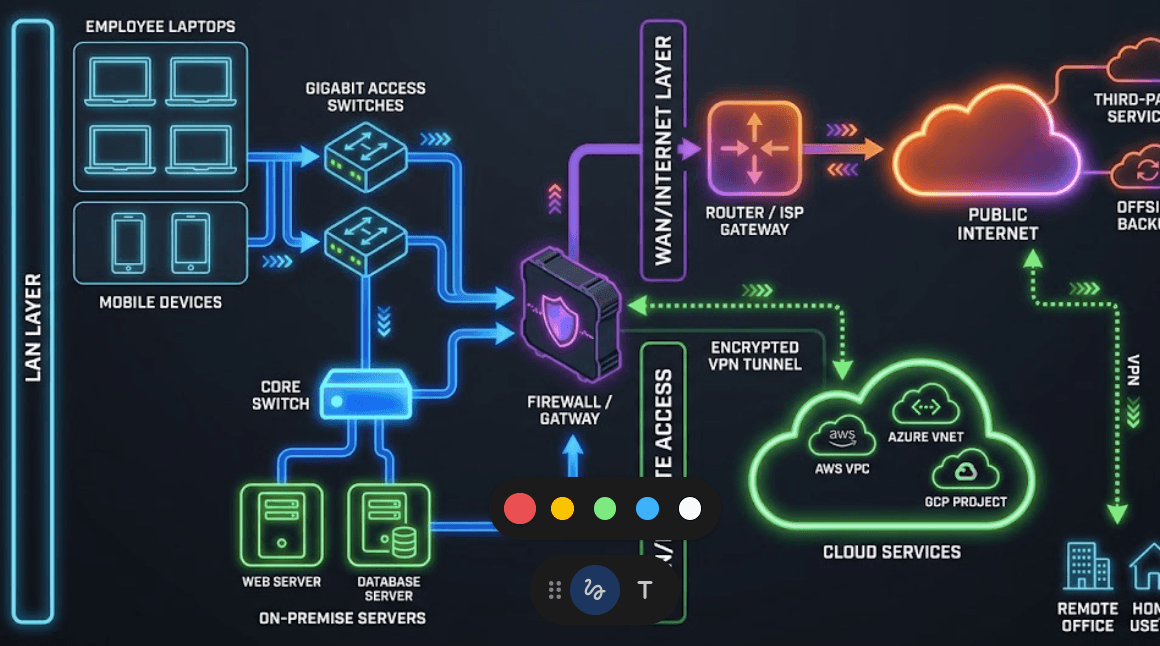
Networking diagram
Network infrastructure is physical, complex, and deeply dependent on real-world variables that change with every new device, every new topology, and every new threat actor on the network. Network engineering requires hands-on setup and physical infrastructure understanding — a combination that AI tools cannot replicate from a prompt window.
Network engineers who understand both the technical and security dimensions of infrastructure are foundational to every organisation that runs anything at scale.
Key competencies:
- Routing, switching, and network protocol design
- Software-defined networking (SDN)
- Network security: firewalls, VPNs, intrusion detection
- Wireless infrastructure design and management
- Network performance monitoring and troubleshooting
Pay Scale:
Swipe to view all columns →
| Position | Estimated Salary (USD) |
|---|---|
| Entry Level | $70,000-$100,000 |
| Mid Level | $100,000-$120,000 |
| Expert Level | $120,000-$150,000 |
10. UX Engineering & Product Design
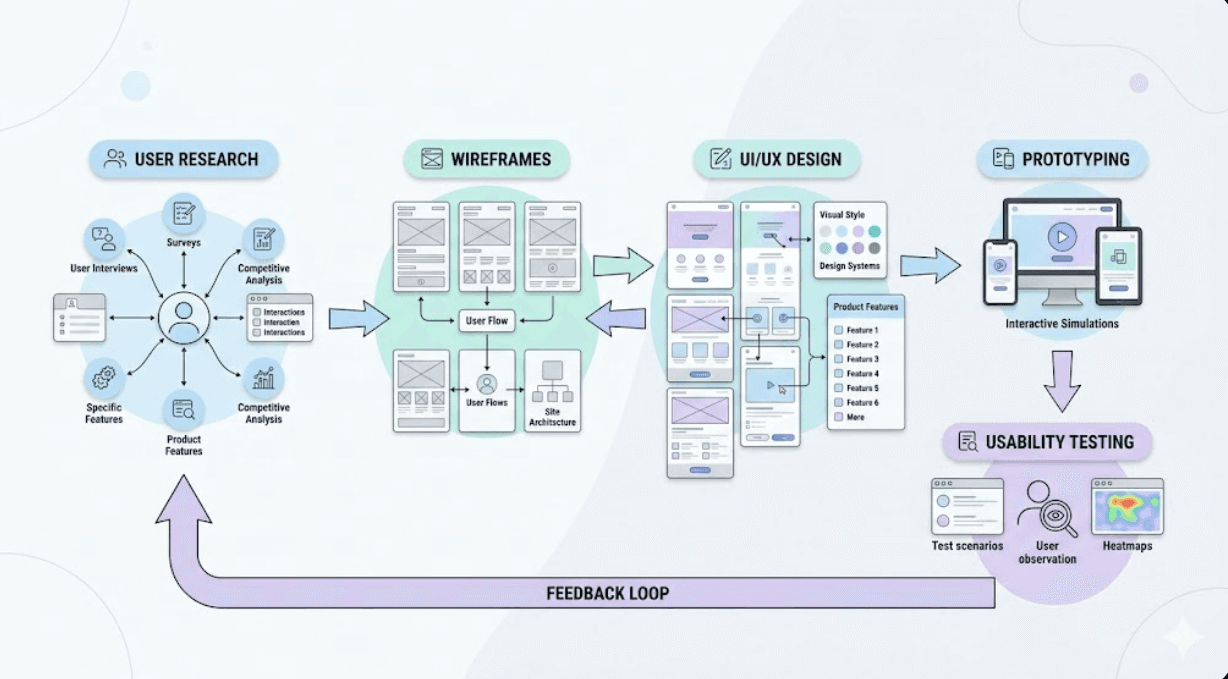
Product design lifecycle from research to feedback
User experience has to do with the way a consumer interacts with a product — and people working in UX figure out the best way to present a product, conducting research, designing, and helping market it. While AI can generate interface mockups and suggest design patterns, it cannot conduct genuine user research, synthesise contradictory qualitative feedback, or make the nuanced judgement calls that turn a functional product into one people actually love using.
UX engineers who sit at the intersection of design thinking and technical implementation are especially valuable — they bridge the gap between what is possible and what is desirable.
Core skills required:
- User research and usability testing
- Interaction design and information architecture
- Prototyping (Figma, Adobe XD)
- Accessibility and inclusive design
- Front-end implementation knowledge (React, CSS, design systems)
Pay Scale:
Swipe to view all columns →
| Position | Estimated Salary (USD) |
|---|---|
| Entry Level | $70,000-$100,000 |
| Mid Level | $100,000-$130,000 |
| Expert Level | $140,000-$160,000 |
Look across these ten disciplines and a clear pattern emerges. Every single one shares the same defining characteristic — they require deep, experience-based, contextual judgement applied to real-world systems where the consequences of being wrong are significant.
That is not a coincidence. It is precisely the category of work that AI cannot confidently own. Not because the technology lacks capability in isolated demos, but because production environments, real organisations, and real stakes demand something that currently sits with humans:
- Accountability — someone has to own the decision and live with the outcome
- Contextual reasoning — understanding why a system behaves the way it does, not just what it is doing
- Adaptive judgement — reading a situation that has never existed before and making the right call anyway
- Domain depth — years of pattern recognition that no prompt can shortcut
Skills are not static credentials. They are moving targets, constantly reshaped by AI breakthroughs, shifting industry demands, and a workplace culture that no longer rewards simply showing up with a degree.
The professionals who build genuine depth in these disciplines — and who combine that depth with a commitment to continuous learning — are not competing with AI. They are the people AI makes significantly more productive.
That is not a modest advantage. It is the difference between a career that compounds in value year over year and one that gets automated out from underneath you.
So here is the actual strategy:
- Pick two disciplines from this list that align with your interests and career direction
- Go deep — not tutorial-deep, but build-real-things deep
- Break them intentionally, then fix them and understand exactly why they broke
- Document your process — the thinking, the failures, the solutions
- Repeat consistently over the next two to three years
That process — applied deliberately and repeatedly — is what future-proof actually looks like. Not in theory. Not in a LinkedIn post but in practice,but in production, and on your resume.
The engineers who commit to this path are not just surviving the AI transition. They are becoming the people every organisation needs most
Frequently Asked Questions (FAQs)
Which tech skills are truly AI-proof?
No skill is completely AI-proof, but the ones most resistant to replacement are those requiring real-world accountability, contextual judgement, and adaptive problem-solving. System architecture, cybersecurity, ML engineering, and database optimisation top that list.
Is software engineering a safe career with the rise of AI?
Yes — at the senior level. AI is increasing demand for engineers who can evaluate, architect, and maintain the output that AI tools generate. Basic, repetitive coding roles face more pressure than advanced engineering roles.
How long does it take to build AI-resistant skills?
Genuine depth in any of the disciplines on this list typically takes two to three years of consistent, applied learning — not watching tutorials, but building real systems, making real mistakes, and understanding why things fail.
Should I specialise in AI and ML to stay relevant?
ML engineering is one strong path, but it is not the only one. Any discipline on this list offers strong career durability. The more important factor is depth: an engineer with three years of embedded systems experience is far harder to replace than one with broad, shallow knowledge across five domains.
Did you go through...?
LAUNCH THE AGENT. KEEP THE HUMAN CONTROL.
START FREE, CONNECT A CHANNEL, AND SHIP YOUR FIRST BOUNDBOT IN MINUTES.