Ada AI & Its Alternatives: The Complete Guide to AI Customer Service Platforms in 2026
Looking for Ada AI alternatives in 2026? You are not alone. This guide breaks down what Ada AI actually does, the five questions you should ask before choosing any AI customer service platform.
30 Mar 2026•10 min read
SEO Content Writer
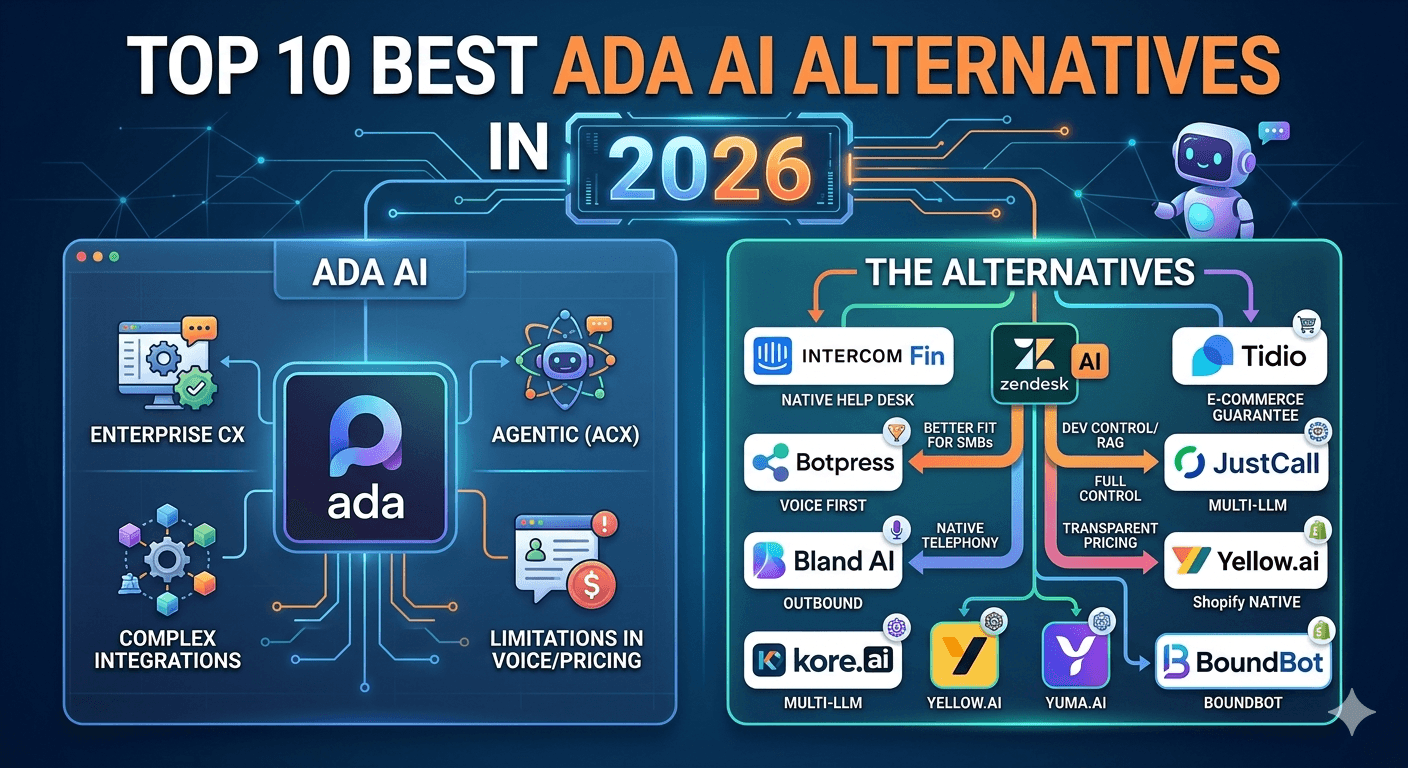
Top 10 Best AI Chatbot Alternatives to Ada AI in 2026 — Complete Guide
Ada AI Alternatives 2026
Ada AI is one of the most recognized enterprise customer service platforms on the market — but it isn't the right fit for every team. Whether you're an SMB (Small and Medium-Sized Businesses) priced out of enterprise contracts, a developer who wants full control, or a business that lives on phone calls, there's a better-matched alternative.
This guide breaks down the top 10 best AI chatbot alternatives to Ada AI in 2026, with an honest look at use cases, pricing, strengths, and trade-offs — so you can choose the platform that actually fits how your team works.
5 Questions Every Business Should Ask Before Choosing Alternatives Of Ada AI
Ada AI Platform
Before you compare alternatives, you need to genuinely understand what Ada AI does, where it shines, and where it quietly struggles. These five powerful questions cut through the marketing noise, delivering clarity where it matters most.
Question 1: What exactly does Ada AI do, and how does it resolve customer issues?
Ada is a purpose-built, chat-first AI platform that automates routine customer support across chat, voice, email, and messaging while escalating complex cases to humans. It relies on intent detection, knowledge retrieval, and integrations to perform real-time actions, enabling teams to deliver consistent service without rewriting every FAQ.
According to Ada's own positioning, the platform delivers:
Swipe to view all columns →
| Metric | Claimed Result |
|---|---|
| Productivity than human | 8X |
| CSAT score increase | 162% increase |
| ROI on AI investment | 357% |
| Automated resolution rate | 84% |
| Uptime | 99.9%+ |
| Languages supported | 50+ |
| Countries operated in | 85+ |
When a customer sends a message, Ada reads it, detects intent and sentiment, retrieves the appropriate knowledge or backend data, and responds or takes action. That pipeline uses natural language processing (NLP) for routing, pre-built connectors to CRMs and helpdesks for account lookup or order updates, and analytics to measure deflection and accuracy, enabling teams to retrain and refine conversation flows. The payoff is predictable: fewer repeat questions and faster first-contact answers.
Question 2: What results does Ada actually claim to deliver?
Swipe to view all columns →
| Feature | Details |
|---|---|
| High Automated Resolution Rates | Ada claims an 84% automated resolution rate on chat, with some users seeing a 34%+ higher resolution rate after replacing traditional chatbots with Ada’s AI |
| Increased Customer Satisfaction (CSAT) | Users have reported a +8 point increase in CSAT after launching Ada's AI agent |
| Reduced Operational Costs and High ROI | Ada highlights a 943% ROI within four months for a client and claims to help turn customer care from a cost center into a growth driver |
| Improved Efficiency | Clients have reported a 42% reduction in average agent handle time |
| Improved Safety and Accuracy | The platform uses built-in safeguards, such as continuous monitoring, to reduce AI hallucinations and ensure safe, accurate responses |
| Omnichannel Support | Ada is designed to work across all channels (chat, email) and languages, providing a consistent “brain” and logic |
Ada has enterprise-level case studies backing them. But metrics only tell half the story. The other half is whether Ada is the right fit for your business model and scale.
Question 3: What industries and use cases is Ada actually built for?
Ada markets itself to enterprises in financial services, gaming, retail, technology, and travel.
Hence, Ada is clearly built for high-volume, multi-channel enterprise environments. If you're a lean team or an SMB looking for quick deployment, Ada's complexity and pricing may work against you.
Question 4: What is Ada's ACX model and why does it matter?
Ada introduced something called the Agentic Customer Experience (ACX) Operating Model — a unified framework bringing together technology, methodology, and expertise to help enterprises build and manage high-performing AI agents at scale.
The ACX model includes three layers:
- ACX Platform — Deploy, orchestrate, and continuously improve AI agents that autonomously resolve conversations across every channel and language
- ACX Practice — Guided by thousands of deployments and millions of conversations, helps you scale from cost savings to customer lifetime value
- ACX Experts — Act as an extension of your team, maximizing ROI and ensuring every AI agent performs at its best
This is not a plug-and-play chatbot. Ada is an enterprise operating system for AI customer experience. That depth comes with setup requirements, a learning curve, and pricing to match.
Question 5: Why do businesses start looking for Ada alternatives?
User feedback from platforms like G2 and Trustpilot reveals recurring frustrations that prompt businesses to explore other solutions:
- Limitations in voice-first depth — Ada lacks comprehensive native telephony features like PSTN management, built-in dialers, and number provisioning.
- Opaque pricing structure — Ada doesn't publish pricing tiers and requires a sales call for custom quotes, which frustrates teams that need quick cost visibility for budgeting.
- Complexity in advanced voice setup — Configuring large-scale outbound campaigns, fallback mechanisms, or detailed dialing logic can demand significant effort.
- Performance trade-offs for voice — Because Ada balances resources across messaging, email, voice, and other channels, voice latency or call quality may suffer.
According to Coworker, a vendor in the Ada alternatives space, over 50% of companies are reportedly considering switching from incumbent chat platforms by 2026, with 60% of users citing high costs and 75% citing limited capabilities as primary reasons for seeking alternatives.
The Top Ada Alternatives in 2026: Honest Breakdown by Use Case
Quick Comparison Table
Swipe to view all columns →
| Platform | Best For | Pricing Starting Point | Key Differentiator |
|---|---|---|---|
| Intercom + Fin | Full-stack helpdesk + AI | $29/seat/mo + $0.99/outcome | Natively integrated AI + helpdesk |
| Zendesk AI Agents | Multi-brand enterprise | $55/agent/mo (Suite Professional seat) | 100,000+ companies, Resolution |
| Tidio | SMBs, e-commerce | Free / $32.50/mo | 67% resolution rate guarantee |
| Botpress | Developer-led technical teams | $79/mo + AI Spend | Open-source, self-hostable |
| JustCall AI Voice Agent | Voice-first SMBs | $29/user/mo + $0.99/min | 30-second setup, native telephony |
| Bland AI | High-volume outbound calling | $0.14/min | Conversational Pathways for developers |
| Kore.ai | Global enterprise, 120+ languages | Custom pricing | Gartner Magic Quadrant Leader |
| Yellow.ai | Enterprise-grade solution | Custom pricing | 35+ channels, 15+ LLMs, 150+ integrations |
| Yuma.ai | Shopify e-commerce | Sales call required | Graduated rollouts, 89% automation |
| BoundBot | SMBs wanting grounded control | Free tier available | One inbox, multi-channel, no vendor lock-in |
Intercom + Fin: The Natively Integrated Alternative
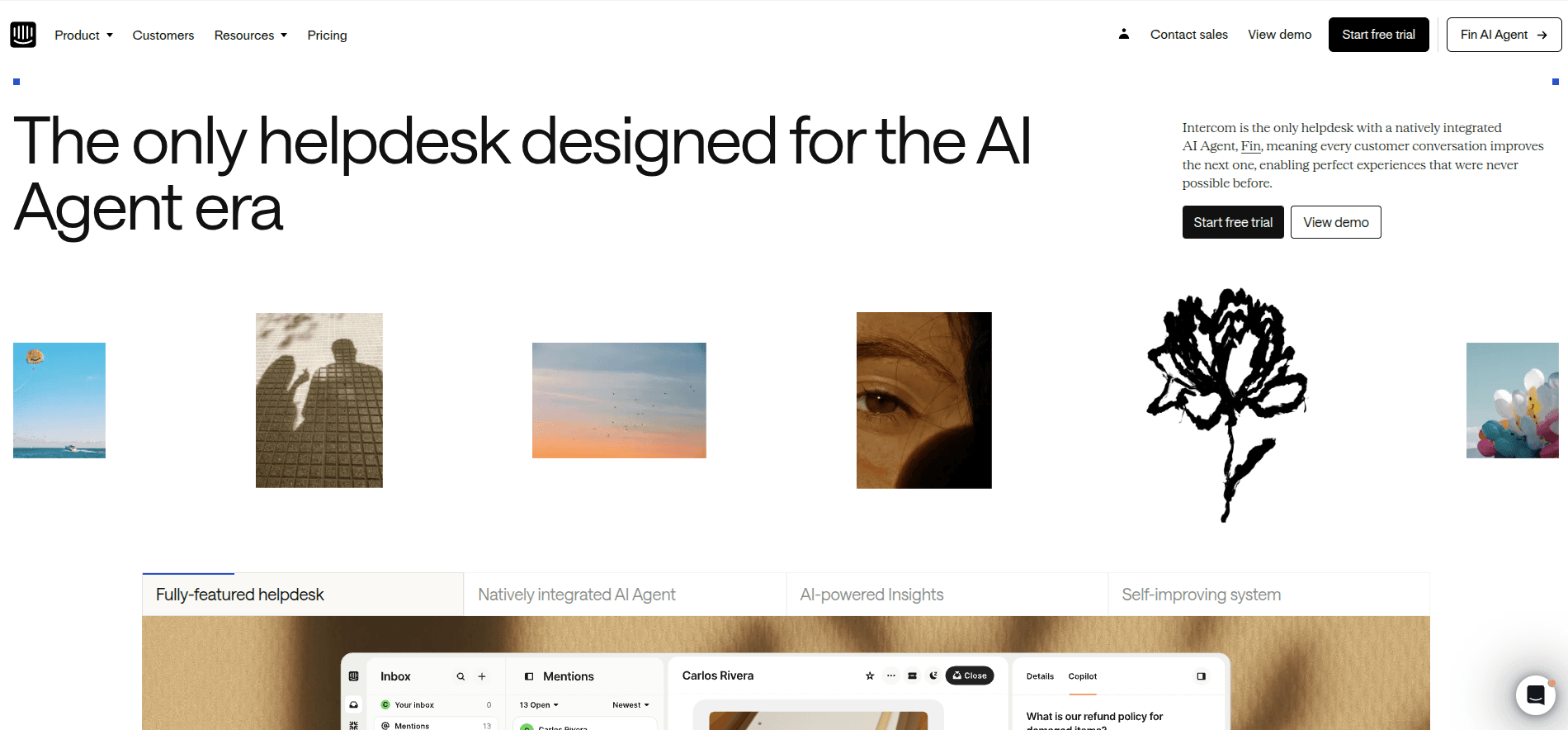
Intercom AI Platform
Intercom positions itself as the only helpdesk with a natively integrated AI agent, meaning every customer conversation improves the next one.
What makes it different from Ada:
Intercom's Fin AI Agent is not bolted onto a helpdesk — it is built into it. This means Fin and your human team work from the same customer record, so handoffs have full context, no one switches between tools, and every customer gets a consistent, seamless experience.
Key capabilities:
- Omnichannel inbox covering email, chat, phone, WhatsApp, and social apps
- AI-powered ticketing with automatic categorization, prioritization, and routing
- Copilot that gives every agent an AI assistant pulling context from past conversations
- AI engine automatically scores and organizes every conversation across Fin and your human team
- 350+ integrations including Salesforce, Stripe, and Jira
Pricing: $29 per seat per month plus $0.99 per resolved outcome
Even Anthropic (the company behind Claude) uses Fin for customer support. According to their Product Support Operations team, for a fast-growing company in a complex space, buying rather than building was the right call.
Zendesk AI Agents: The Enterprise-Scale Option
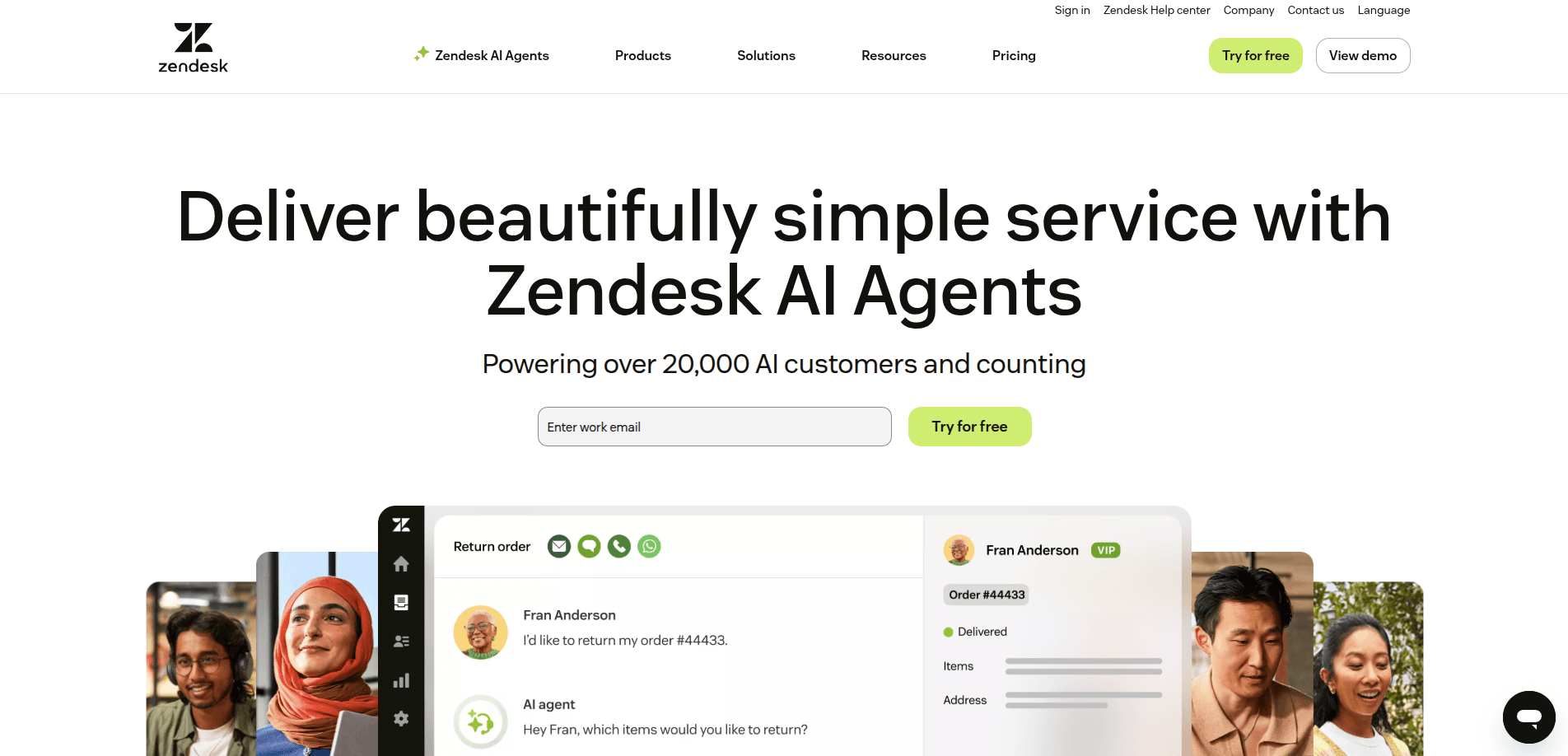
Zendesk AI Platform
Zendesk powers over 100,000 companies and over 20,000 customers, making it one of the most battle-tested platforms in this space.
What makes it stand out:
Zendesk introduced the Resolution Learning Loop™ — a system that applies AI to unified interaction data, continuously increasing automation rates and quality with every resolved conversation. The claim is automation of 80%+ of interactions by connecting AI, human agents, and knowledge on one platform.
Published ROI from Forrester's Total Economic Impact study:
- 301% average ROI over three years
- $23.2 million net present value over three years
- 6 months to payback
Key capabilities for multi-brand teams:
- Manages AI agents representing multiple brands from a single account
- Multilingual response AI agents automatically reply in the same language as incoming messages
- Deployment to Facebook, Instagram, X, WhatsApp, WeChat, and more
Pricing: Suite Team starts at $49/agent/month, with AI Agents (Essential) included from $55/agent/month
Tidio: The SMB-Friendly Alternative with a Bold Guarantee
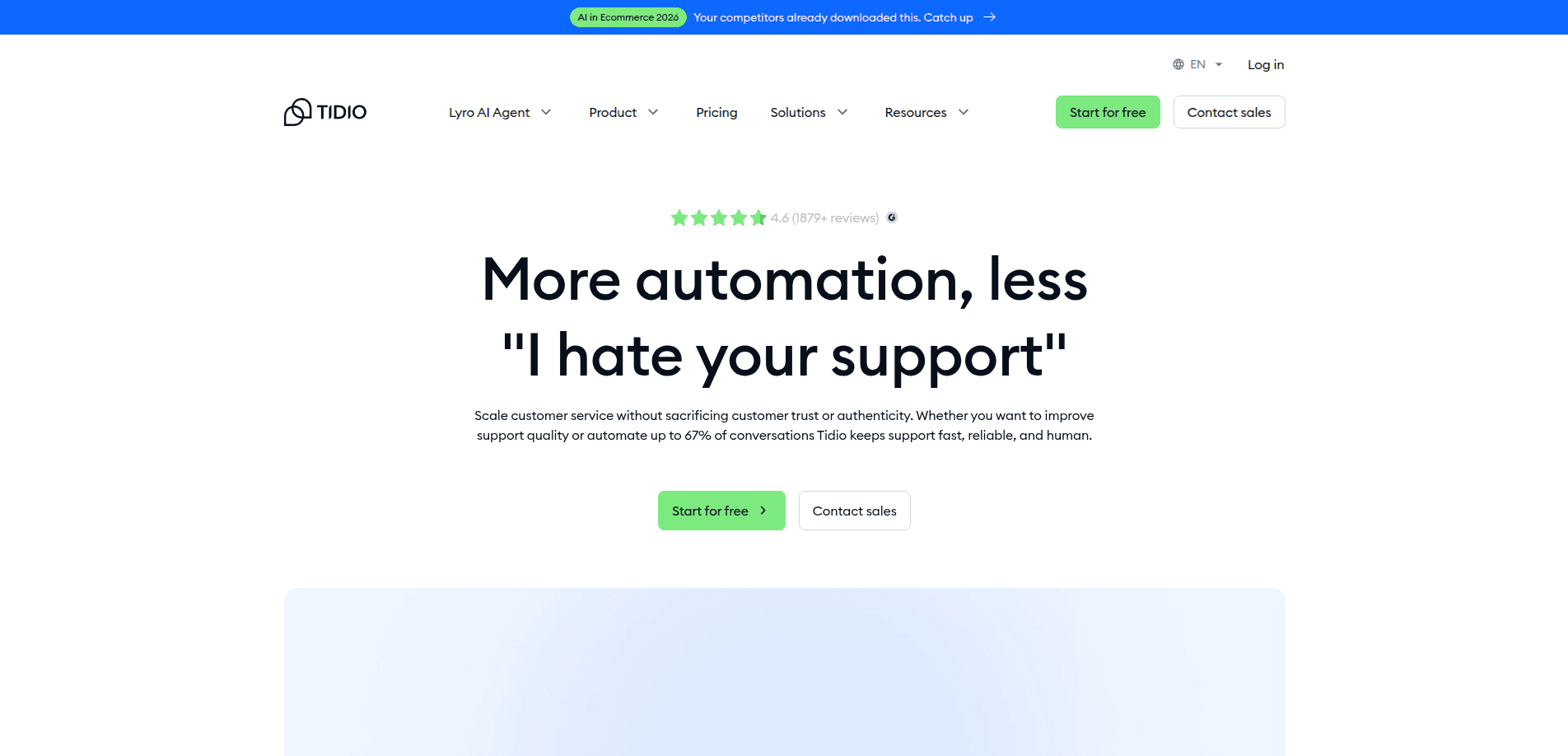
Tidio AI Platform
Tidio takes a direct shot at every AI platform making vague resolution rate promises: if they don't lift your resolution rate to at least 50%, you get your money back.
Tidio's Lyro AI Agent currently claims the highest resolution rate in the industry at 67%, backed by over 300,000 businesses.
Real results from published customer data:
- 90% of repetitive tasks handled by Lyro AI Agent (Gecko Hospitality)
- $66K+ in revenue generated by Lyro AI Agent (Bella Sante)
- 70% increase in self-service resolution (Cove)
- 89% resolution rate with Lyro AI Agent (Cove)
- 30% CSAT increase (ADT)
What Tidio does that Ada doesn't prioritize:
Behavior-based chatbot triggers and actions let you configure responses based on real visitor behavior — not just keywords. It's also one of the most e-commerce-native platforms, with deep Shopify integration and cross-selling templates like the Cart Booster.
Pricing: Free plan available. Paid plans start at $32.50/month.
Botpress: For Developer-Led Teams Who Want Full Control
Botpress AI Platform
Botpress is an open-source, self-hostable platform for building AI agents powered by retrieval-augmented generation (RAG).
Why developers choose Botpress over Ada:
- Full control over LLMs — pick your model from a long list of providers
- Memory that persists across user sessions
- Traditional coding environment alongside a drag-and-drop builder
- Works with most APIs, meaning you can integrate it with almost anything
- Self-hostable for maximum privacy and security guarantees
The honest trade-off: Botpress comes with long rollout periods and significant maintenance requirements. This is not a tool for non-technical teams.
Pricing: Pay-as-you-go plan free plus AI Spend. Paid tiers from $79/month plus AI Spend.
JustCall AI: The Voice-First Alternative Ada Misses
JustCall AI Platform
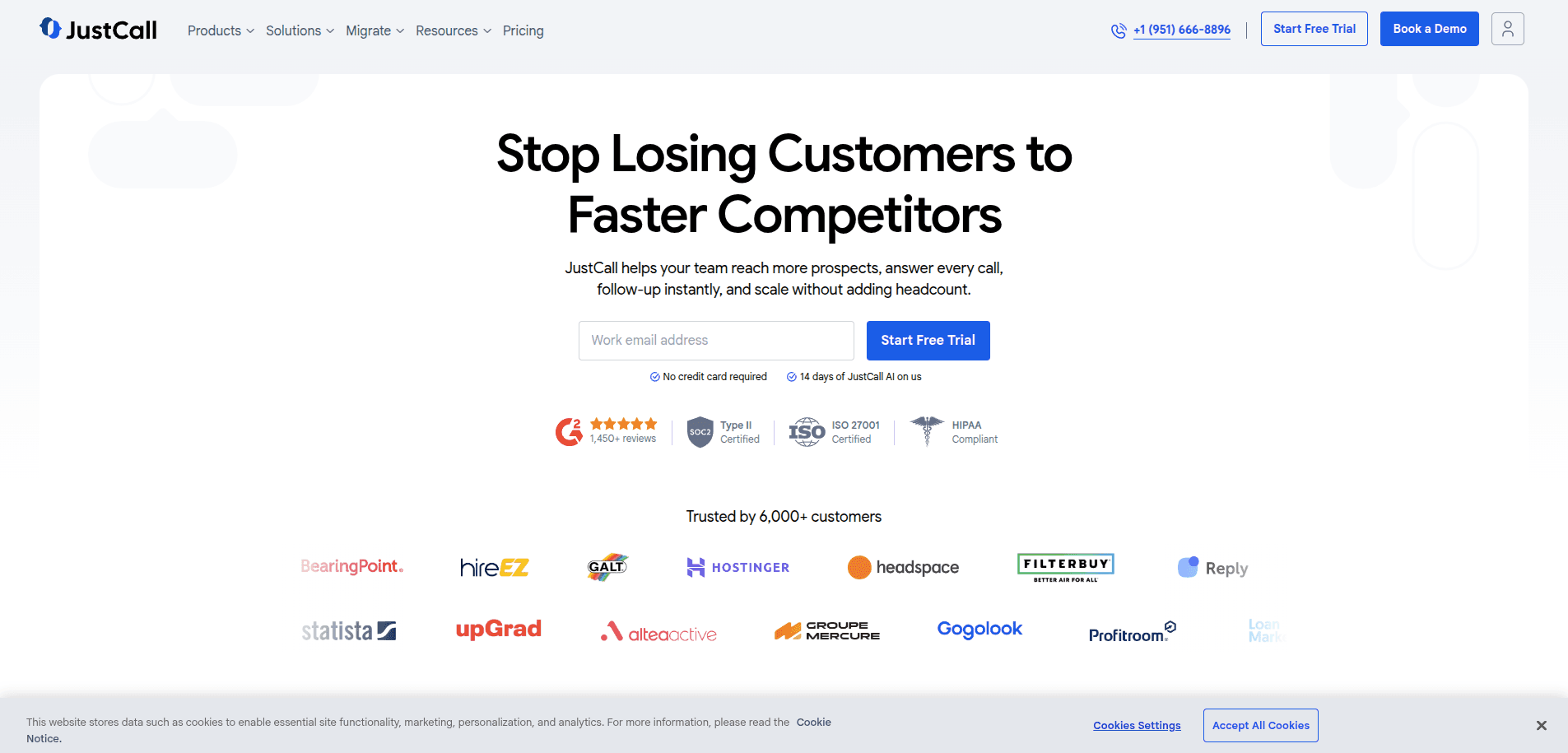
If your business lives and dies on phone calls, Ada's omnichannel architecture may actually work against you. JustCall is built with telephony at its core.
Where JustCall wins vs. Ada:
- Create a voice AI agent in under 30 seconds vs. Ada's longer omnichannel configuration cycle
- Transparent pricing from $29/user/month plus $0.99/minute — no custom quotes or enterprise contracts needed
- Native telephony, SMS, and WhatsApp — no external carrier required
- Local numbers in 70+ countries
- Supports 14+ languages
- Compliant with SOC 2, GDPR, and HIPAA
Real customer results:
- Answers up to 25% more calls without adding headcount
- Recovers up to $3,000/day from previously missed calls
- 80% of inbound calls resolved by AI (reported by a solar industry professional)
Best for: SMBs and mid-market teams that want voice automation without the complexity of an enterprise omnichannel deployment.
Bland AI: High-Volume Outbound Calling at Transparent Pricing
Bland AI Platform
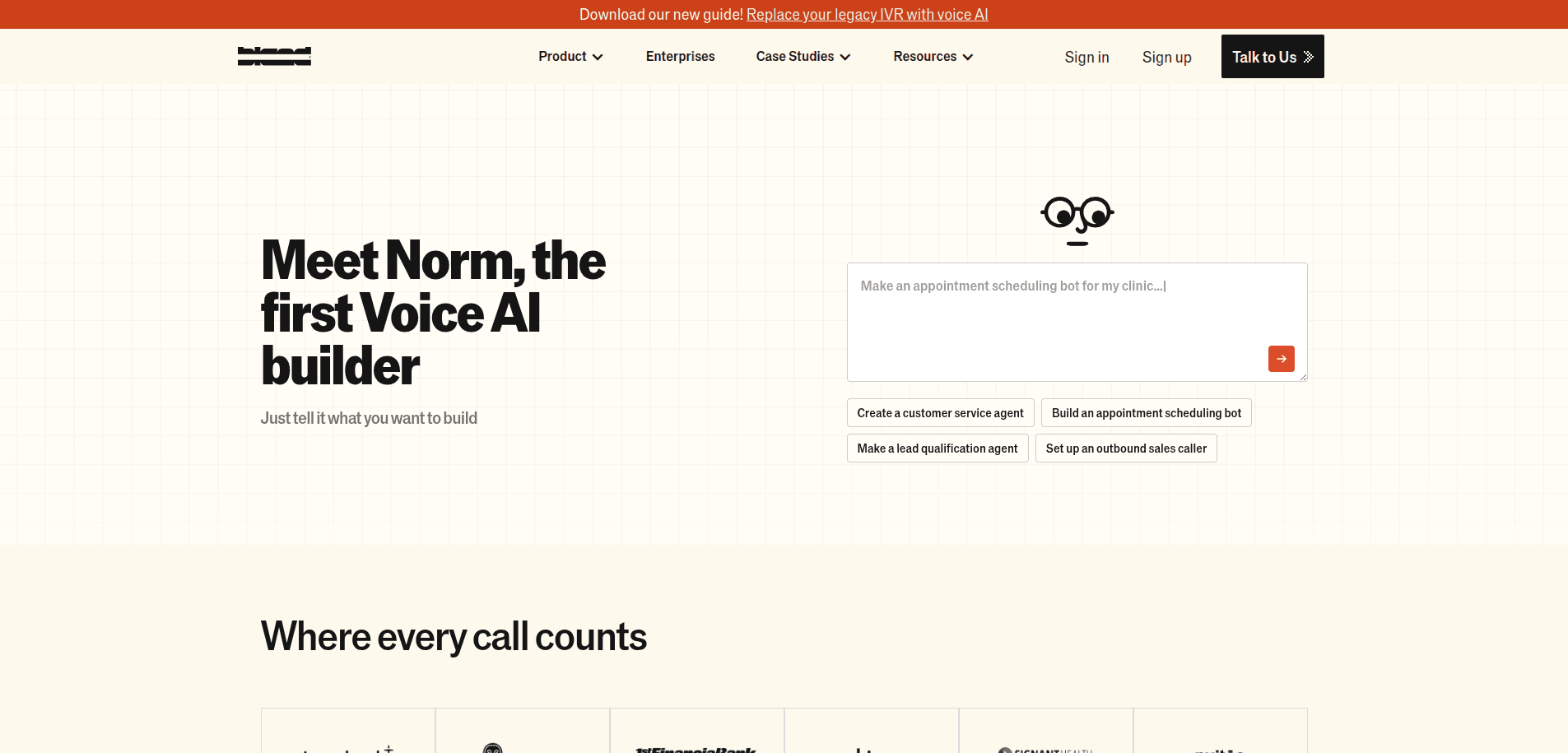
Bland AI is a voice automation platform with a developer-first design. Its standout feature is "Conversational Pathways," which gives technical teams fine-grained control over how calls are structured and handled.
Published performance metrics:
- 65%+ first-call resolution across all deployments
- Live in 30 days from kickoff to production-grade agents
- $100s of millions saved in annual cost reduction for enterprise customers, according to Bland AI
- Millions of calls automated
Pricing: $0.14/minute(Connected Minute Rate), transparent and published.
Limitation to know: Primarily optimized for outbound — inbound capabilities are less robust.
Kore.ai: The Analyst-Recognized Enterprise Leader
Kore.ai Platform
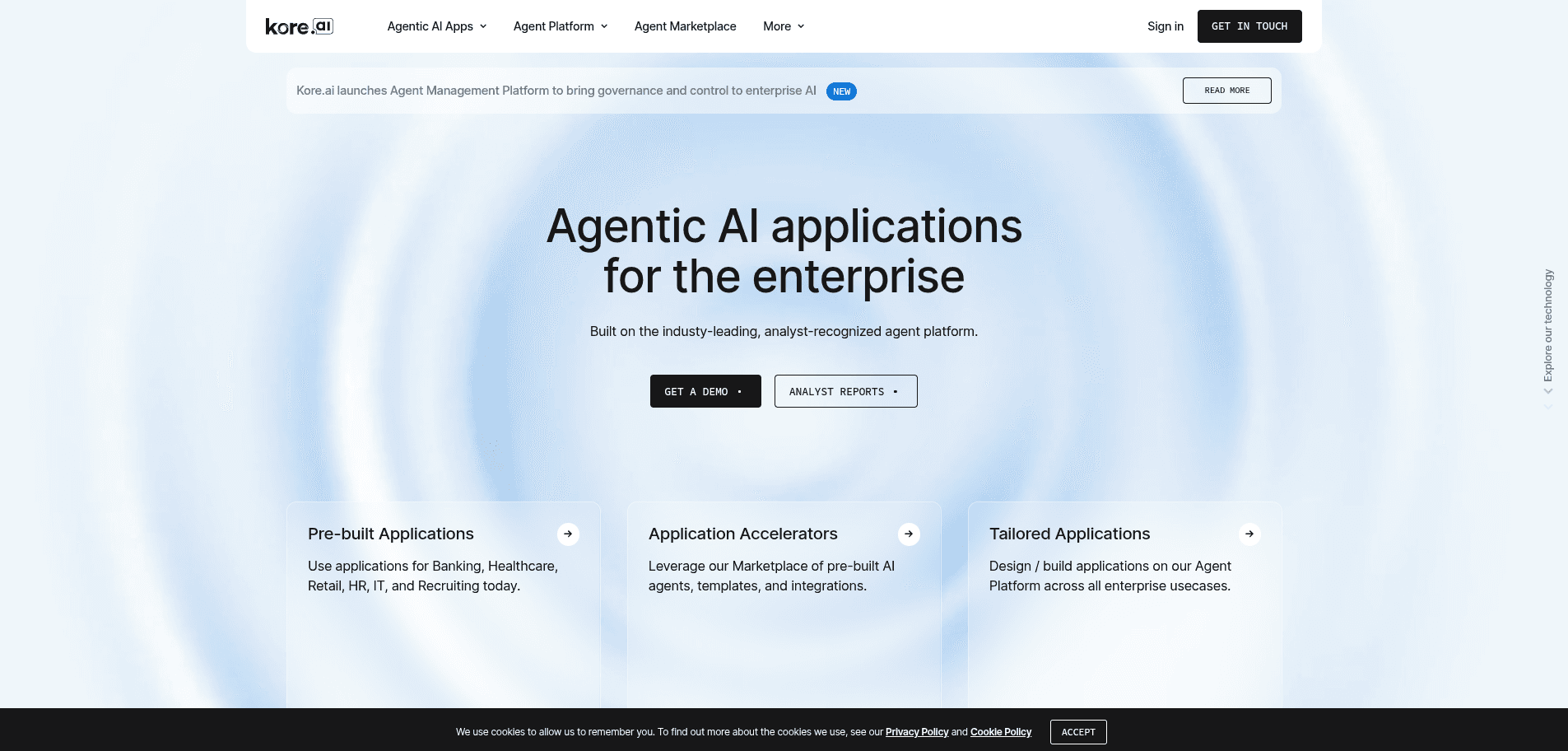
Kore.ai is named a Leader in the Gartner Magic Quadrant for Conversational AI Platforms and supports deployments across banking, healthcare, retail, telecom, and enterprise operations.
Scale of real deployments:
- Pfizer has deployed 60 AI agents across research, development, medical, commercial, and manufacturing globally
- Eli Lilly's service desk now handles 70% of requests via AI
- Autodoc reports 74% first-call resolution with significant savings
- Morgan Stanley uses Kore.ai to give financial advisors 15-20 minutes back each day
Key differentiator: 120+ language support, pre-built industry templates, and integration with both Microsoft Azure AI Foundry and AWS Amazon Bedrock for enterprises already inside those ecosystems.
Pricing: Custom enterprise pricing.
Yellow.ai: The Global Multi-LLM Omnichannel Platform
Yellow.ai Platform
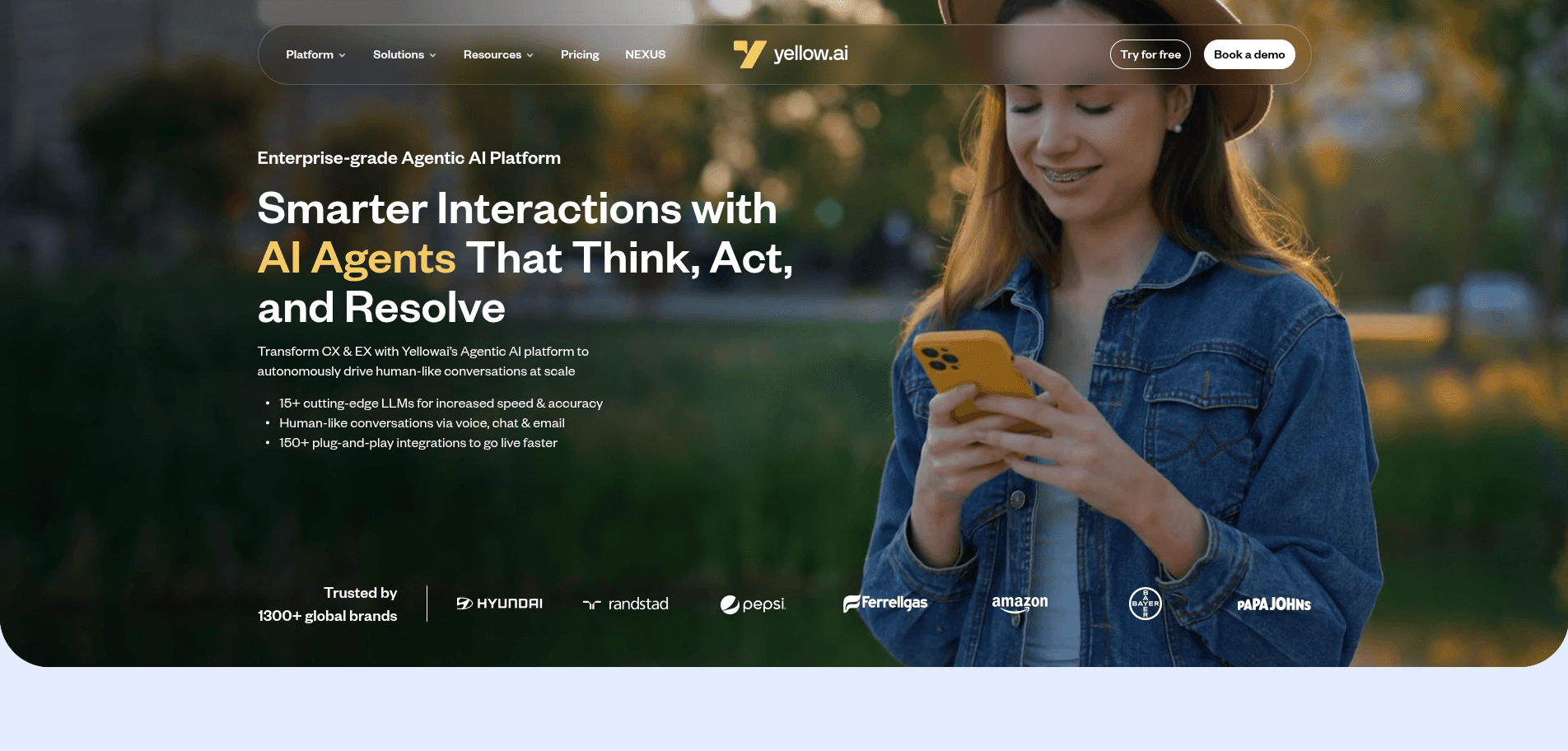
Yellow.ai supports 35+ digital and voice channels and uses 15+ cutting-edge LLMs through a multi-LLM architecture, avoiding vendor lock-in while maximizing performance for each specific task.
What sets it apart from Ada:
- 150+ plug-and-play integrations including Salesforce, Zendesk, Genesys, and Nice
- Supports 135+ languages for voice
- Automated testing within a single interface for fast and robust deployments
- Compliant with HIPAA, ISO 27001, ISO 27701, SOC 2 Type II, PCI-DSS
Published results from a BPO customer: Launched a fully functioning AI-powered chat in six weeks that now automates more than 70% of customer interactions, with reduced costs and agents focused on high-value conversations.
Limitation to note: Yellow.ai does not include its own voice telephony stack — a separate carrier is required.
Yuma.ai: E-Commerce AI That Respects the Risk of AI
Yuma.ai Platform
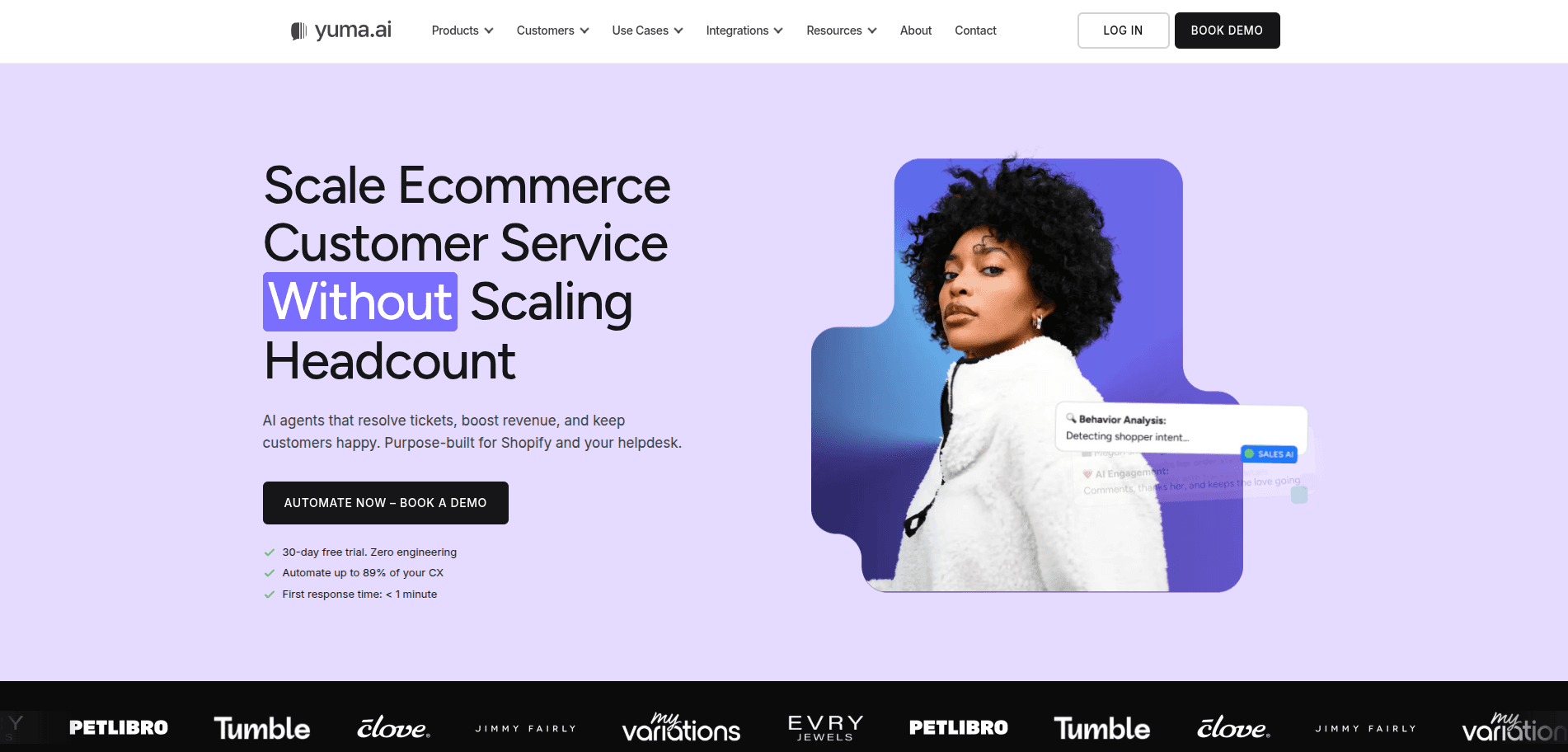
Yuma.ai wins points for being realistic about how dangerous one-click deployments can be. It's the only platform reviewed with graduated rollouts — limiting new agents to a certain percentage of responses in a given channel, region, or device cohort before full deployment.
Hard guardrails built in: No hallucination or user manipulation results in unexpected refunds, discounts, or loyalty point losses.
Published automation results from e-commerce brands:
- EvryJewels: 89% automation rate
- Petlibro: 79% automation rate
- Tediber: 64% automation, response time cut from 72 hours to under 1 hour
- Clove: 70% automation, 3x ROI, first response time under 3 minutes within 90 days
Best for: Shopify-native e-commerce brands. Yuma integrates with Gorgias, Zendesk, Klaviyo, Loop Returns, ShipStation, and 100+ more.
BoundBot: The Grounded, Human-in-the-Loop Alternative for Teams Who Want Control Without Chaos
BoundBot AI Platform
If you've read this far, you understand the real problem: most AI customer service platforms ask you to choose between capability and control. Either you get a powerful enterprise platform with a year-long implementation and a pricing model that requires a sales conversation, or you get a basic chatbot that hallucinates and breaks the moment a customer asks something off-script.
BoundBot is built for the teams caught between those two extremes.
Here's what makes BoundBot different from everything else on this list:
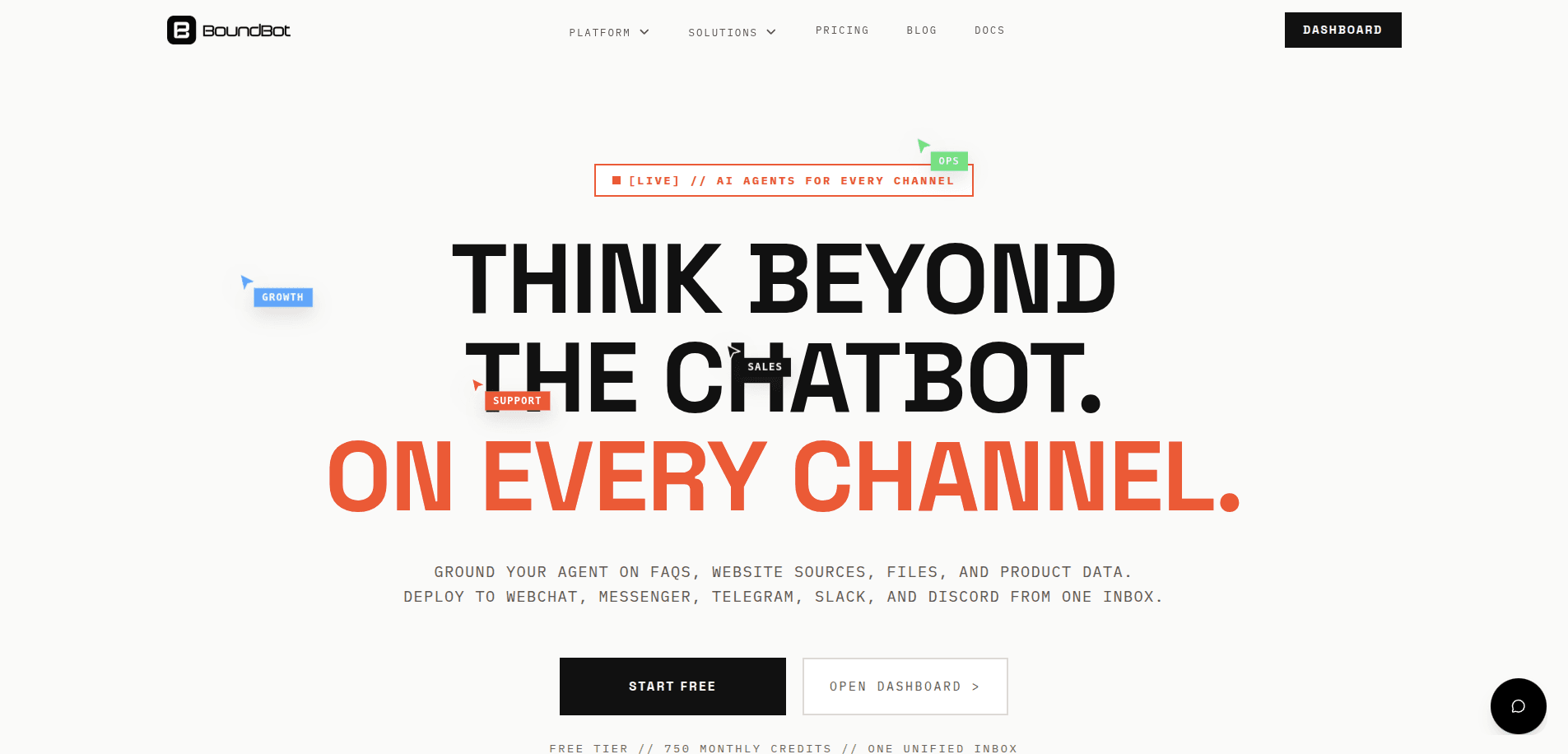
Grounded answers, not guesswork: BoundBot ingests your website pages, FAQs, product catalog, and files — and every answer starts from that real context. Your customers don't get hallucinated responses. They get answers grounded in what you actually said.
One inbox, not six disconnected tabs: Every conversation from WebChat, WhatsApp, Messenger, Telegram, Slack, and Discord lands in one unified inbox. You review threads, step in live when needed, and automate repeats with keyword rules — all from one place.
Human handoff that actually works: BoundBot is built around the reality that AI should not handle everything. When a conversation becomes operational, it needs judgment, not just retrieval —then a human steps in. No awkward re-routing. No context lost. No customer starting over.
AI plus deterministic rules: Unlike platforms that bet everything on LLM improvisation, BoundBot lets you combine AI responses with keyword rules. Handle repeated, predictable messages with exact-match logic. Let AI handle nuance. Use each where it belongs.
Deploy everywhere from one config: WebChat, WhatsApp, Messenger, Telegram, Slack, Discord. One agent. One knowledge base. One workspace. The same answer, adapted to each platform.
Free tier to start: BoundBot offers a free tier with 750 monthly credits and one unified inbox. You can start, connect a channel, and ship your first agent in minutes — no vendor contracts, no enterprise sales cycle, no hidden costs.
Who BoundBot Is Built For
Support teams that are tired of answering the same FAQ across six different tabs — BoundBot grounds the reply once and reuses it everywhere.
Revenue teams that want to turn pre-sale questions into qualified conversations using product knowledge and lead capture instead of losing chat windows.
Lean operators who need human control with a real inbox, live takeovers, and deterministic rules in the places where AI should not be improvising.
Key Features to Compare When Choosing an Ada Alternative
Before you pick any platform, run every candidate through these dimensions:
Automation and AI depth
- Does it handle multi-step workflows or just FAQs?
- Can it authenticate users, retrieve account data, and execute backend actions in a single conversation?
Voice capabilities
- Is telephony native or does it rely on a third-party carrier?
- Does it support inbound and outbound, or only one direction?
Omnichannel consistency
- Does one reasoning layer power all channels, or are they siloed?
- If you update a policy in chat, does voice automatically reflect it?
Ease of deployment
- How long from kickoff to production?
- Does setup require engineers or can non-technical teams own it?
Pricing transparency
- Is pricing published or hidden behind a sales call?
- Is it per seat, per resolution, per minute, or per conversation?
Compliance and security
- Does it meet SOC 2, GDPR, HIPAA for your industry?
- Where does customer data go during AI processing?
Integration ecosystem
- Does it connect natively to your CRM, helpdesk, and e-commerce stack?
- Or does everything run through Zapier?
Conclusion
The AI customer service landscape in 2026 is not short on options. What it's short on is honest platforms that respect both your customers and your team's operational reality. Ada is a serious enterprise platform with serious results. So are Intercom, Zendesk, Kore.ai, and Yellow.ai for the organizations they're built for.
But if you're a team that wants to deploy AI that actually stays grounded, gives humans control when it matters, and doesn't require a six-figure contract to get started — BoundBot is worth a serious look.
Start free. Connect a channel. Ship your first agent in minutes.
Have you read?
- AI Chatbot Pricing Comparison 2026: What Businesses Need to Know
- How to Build A Multi-Channel Chatbot Setup (WhatsApp, Instagram, Telegram & WebChat)
- BoundBot vs. ChatGPT Custom GPTs: When You Need a Real Chatbot Platform
LAUNCH THE AGENT. KEEP THE HUMAN CONTROL.
START FREE, CONNECT A CHANNEL, AND SHIP YOUR FIRST BOUNDBOT IN MINUTES.