
The AI Slop Crisis: Why Authenticity Is the Internet's Most Valuable Currency in 2026
Fake images, hollow blog posts, viral videos that never happened — the AI slop crisis is everywhere. Find out how to protect your brand, build real trust, and win in a web drowning in synthetic content.
06 Apr 2026•5 min read
SEO Content Writer
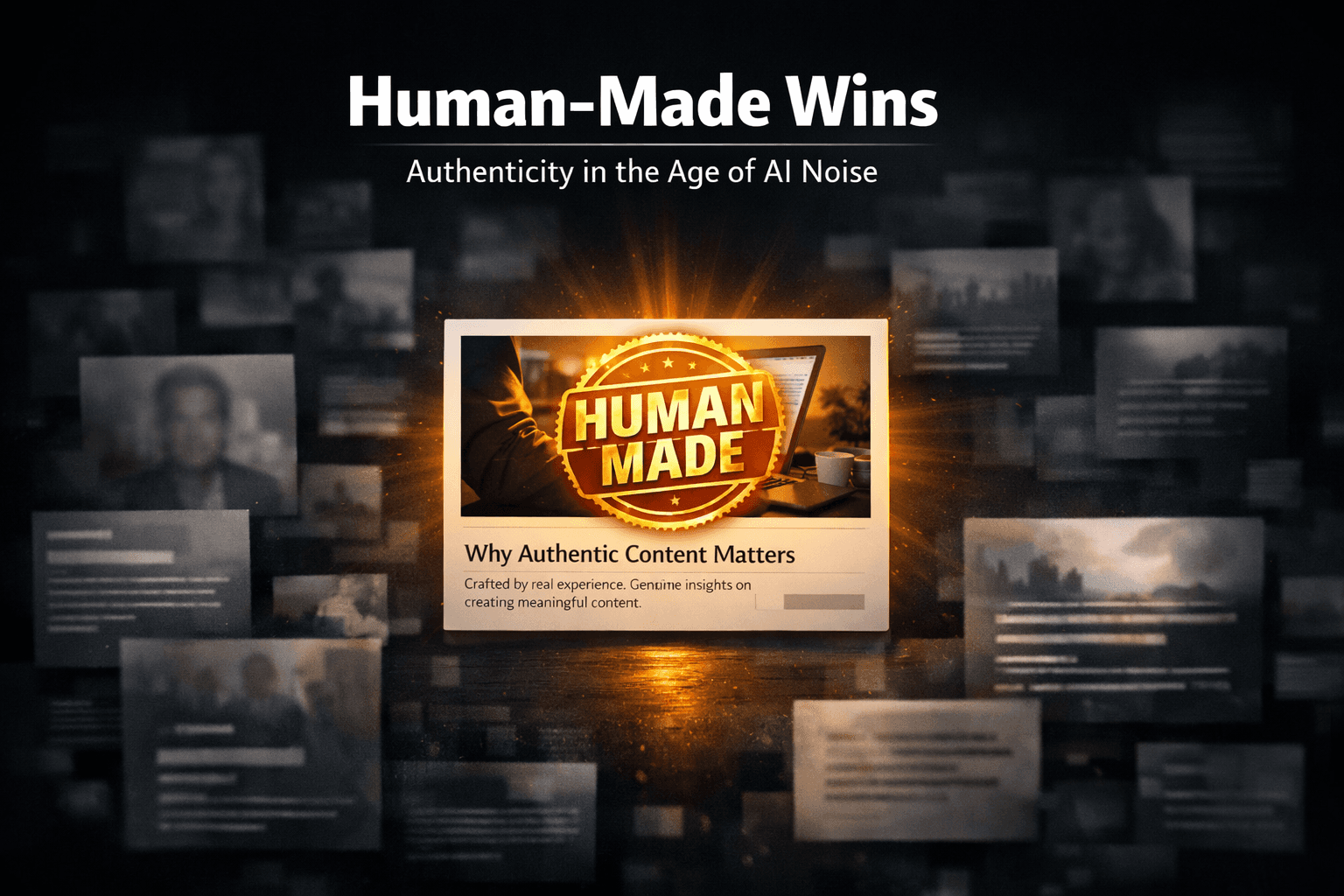
The AI Content Flood
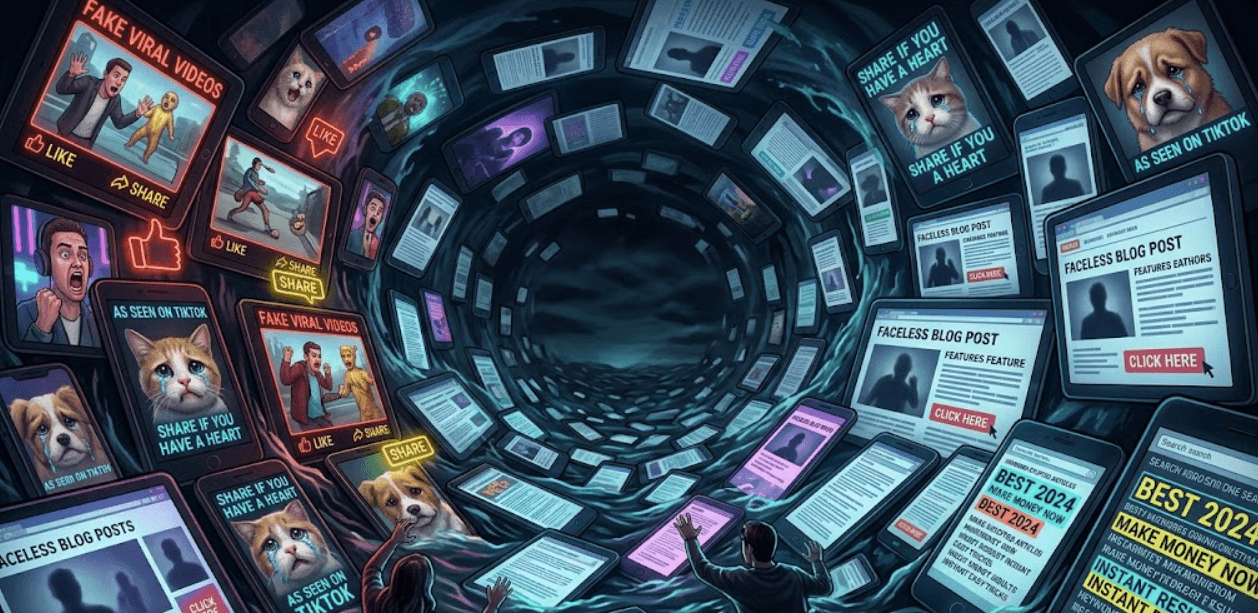
AI content overload
The internet is drowning — not in water, but in something far more insidious: the AI slop crisis.
Scroll through your Facebook feed, browse YouTube Shorts, or run a Google search today, and you will encounter it almost immediately: Fake images of crying animals. Faceless blog posts stuffed with keywords. Viral videos of things that never happened.
What started as a productivity revolution has quietly become one of the most significant information-quality crises in digital history. And in 2026, the backlash is real, loud, and growing.
What Exactly Is AI-Generated Content Slop?
AI Slop refers to high-volume, low-effort content — text, images, and video — mass-produced by generative AI tools, designed not to inform or entertain, but to game algorithms for clicks and advertising revenue.
According to iPullRank's AI Search Manual, a Stanford University study analyzing over 300 million documents showed a sharp surge in AI-generated content following the launch of ChatGPT in late 2022. Today, estimates suggest that 52% of all online content is AI-generated and that number keeps climbing.
While many sources suggest a 90% AI-generated internet by 2026, some industry analyses indicate a potential "plateau" where the web remains roughly split between human-written and AI-generated content, largely because high-quality human content is still preferred for search rankings.
The Growing Backlash: People Are Fed Up
According to BBC, the experience of using social media has changed profoundly over just two to three years. Viral AI-generated images — emaciated children in strange scenarios, religious imagery fused with sea creatures, and disaster footage that never occurred have flooded platforms and racked up millions of likes from users who never questioned their authenticity.

Brain Rot Picture(Blurred)
The pushback is now impossible to ignore:
- Reddit threads with 21,000+ upvotes document widespread frustration, with users describing the internet as feeling "broken," "fake," and "exhausting"
- On platforms like TikTok and Instagram, backlash comments under AI videos frequently outnumber the likes on the original post
- Users report "AI fatigue" — the mental exhaustion of constantly asking "is this real?"
Researchers warn of a "brain rot" effect, where the constant flood of low-quality synthetic content further reduces people's attention spans and erodes their ability to think critically.
The AI Slop Crisis Is Your Opportunity
For marketers and businesses, AI slop isn't just an ethical issue — it's a direct threat to visibility and revenue.
Google's E-E-A-T framework (Experience, Expertise, Authoritativeness, Trustworthiness) is now more critical than ever. Here is what that means for content strategy in 2026:
Swipe to view all columns →
| Signal | What AI Slop Lacks | What You Need Instead |
|---|---|---|
| Experience | No real-world context | Case studies, firsthand insight |
| Expertise | Generic pattern-matching | Verified author credentials |
| Authoritativeness | No cross-platform presence | Podcasts, industry mentions, press |
| Trustworthiness | No source transparency | Citations, methodology disclosure |
Based on Ahrefs research published in May 2025 (and updated with 2026 insights), the surge in AI-generated content is fundamentally changing the digital landscape, with studies showing that AI-assisted or generated content accounts for over 70% of new web pages. Study shows that of 900,000 new pages in April 2025 revealed that 74.2% contained AI-generated content, with AI-assisted content becoming "table stakes" for content creation.
This is what researchers call model collapse where each generation of AI content becomes more generic, less accurate, and less grounded in reality.
Why Human Content Beats AI-Generated Content in 2026

Office Meeting
Here is the paradox that 2026 has revealed: the more AI floods the internet, the more valuable genuine human content becomes.
Brands that invest in original research, real expertise, and authentic storytelling are increasingly becoming the default reference points that AI systems cite. This is not just good ethics — it is good strategy.
Key shifts happening right now:
- Original data and proprietary research are cited by AI search engines because they cannot be replicated or scraped
- Cross-platform authority — appearing in trusted publications, podcasts, and panels — carries far more weight than a high-volume content calendar
- Depth over velocity: one well-researched, experience-driven article now outperforms ten AI-generated blog posts for long-term visibility
As noted in Medium's analysis of the slop phenomenon, slop is not about AI versus humans — it is about the divergence between what we claim to optimize for and what we actually measure. The moment velocity replaces value, content stops serving people and starts serving metrics.
Newly launched — you may find these useful:
- 10 Tech Skills AI Cannot Replace in 2026 For Your Career
- Stop Writing Upwork Proposals From Scratch: Build Your Own Proposal Bot Using Your Resume (Step-by-Step System)
Deepfakes and the Rise of Provenance Technology
Beyond low-quality text and images, the crisis has a darker dimension. Deepfake video and synthetic media are growing at an exponential rate, projected to reach 8 million shared instances this year — up from roughly 500,000 in 2023.
AI-generated videos are already being used to spread geopolitical misinformation — fake footage of civilians reacting to military events, designed to shape public opinion at scale.
The response? A surge in investment in provenance technology — tools that cryptographically prove content is real:
- C2PA (Coalition for Content Provenance and Authenticity) — an industry standard for tagging authentic media at the point of creation
- Digital watermarking — invisible markers embedded into genuine images and videos
- Origin verification platforms — services that allow creators to publicly prove their content's source
As one expert told BBC: "We are already at the point where you cannot confidently tell what is real by inspection alone. Instead of trying to detect what is fake, we need infrastructure that allows real content to publicly prove its origin."
What This Means for Your Content Strategy
The 2026 content landscape rewards one thing above all else: verified, purposeful, human-led creation.
Whether you are a brand, creator, or marketer, the playbook has changed:
- ✔ Publish original research that AI systems have no choice but to cite
- ✔ Build cross-platform authority across trusted channels, not just your website
- ✔ Prioritize transparent sourcing — cite your data, disclose your methods
- ✔ Invest in provenance tools to authenticate your visual content
- ✘ Avoid prompt-to-publish workflows with no human judgment at any stage
- ✘ Stop chasing content volume at the expense of depth and credibility
The Bottom Line
2026 is the year "Made with AI" stopped being a flex and became something that demands scrutiny. Platforms are scrambling to respond. Users are exhausted and increasingly skeptical. Search engines are quietly rewarding the brands that never abandoned quality in the first place.
The internet's most valuable currency right now is not content. It is trust — and trust, by definition, cannot be generated at scale. The brands and creators who understand this will not just survive the AI Slop era. They will own it.
LAUNCH THE AGENT. KEEP THE HUMAN CONTROL.
START FREE, CONNECT A CHANNEL, AND SHIP YOUR FIRST BOUNDBOT IN MINUTES.