
What 50 Social Media Enquiries Could Be Worth: A ৳30,000 Sales Example
Work through a hypothetical BDT 30,000 sales example from 50 social enquiries. Separate orders, extra revenue, margins, and collected payment.
10 Nov 2026•7 min read

SEO & Content Marketing Specialist
You finish a busy week with dozens of customer messages. People asked about prices, colors, delivery, and availability. It felt productive. But how much business came from those conversations?
That question is easy to lose when you are replying all day. A busy inbox can include serious buyers, existing customers, duplicate questions, and people who are only browsing.
Let’s work through a simple example of turning social media enquiries into sales. The numbers below are hypothetical inputs for planning. You can replace them with your own figures to see where your next improvement might matter.
Start with unique enquiries, not the number of messages
One person may send five messages about the same product. If you count those as five new opportunities, your sales calculation will look better than the business actually is.
For this example, assume a small online shop receives 50 unique buying enquiries during a November campaign. Each person is counted once for that purchase opportunity. Existing order-support requests stay in a separate group.
The shop’s average completed order is ৳2,000. We will compare different enquiry-to-order rates while holding that order value constant.
This gives us a straightforward formula:
Completed orders × average order value = gross sales value.
It does not tell us profit yet. We will get to costs after we understand the sales.
How 50 enquiries could become ৳30,000 in sales
Suppose 15 of those 50 people complete an order. That is a 30% enquiry-to-order rate. At an average order value of ৳2,000, the gross sales value would be ৳30,000.
Here is how the same 50 enquiries look under three assumed outcomes:
Swipe to view all columns →
| Assumed enquiry-to-order rate | Completed orders | Average order value | Gross sales value |
|---|---|---|---|
| 20% | 10 | ৳2,000 | ৳20,000 |
| 30% | 15 | ৳2,000 | ৳30,000 |
| 40% | 20 | ৳2,000 | ৳40,000 |
These rates are scenarios, not benchmarks or expected results. Your product, audience, price, stock, and delivery arrangements will affect what happens.
The useful question is where people stop between asking and ordering. That gives you something more practical to improve than a general goal to “get more engagement.”
Find the point where interested people get stuck
Read a sample of unfinished enquiries. What was the last question before the conversation stopped?
You may find that buyers wanted a delivery total, needed help choosing a variant, or waited for someone to check stock. Some will simply have decided not to buy. Record what you can actually observe rather than treating every unfinished chat as a lost sale.
A short review sheet can include the product, the question, the last useful answer, the next action, and the eventual outcome. Use categories your team can apply consistently.
If delivery charges appear repeatedly, publish them more clearly. If size questions keep blocking orders, improve your size information. If your staff have conflicting answers, agree on the current policy before adding more automation.
Move the enquiry forward one step at a time
Swipe to view all columns →
| Stage | Useful action | Record |
|---|---|---|
| Product question | Answer the approved facts | Product and requested variant |
| Missing detail | Ask one relevant question | What the customer still needs |
| Operational check | Give the check an owner | Owner and expected reply time |
| Order decision | Confirm the total and terms | Order reference if created |
| Final outcome | Reconcile fulfillment and payment | Collected value and adjustments |
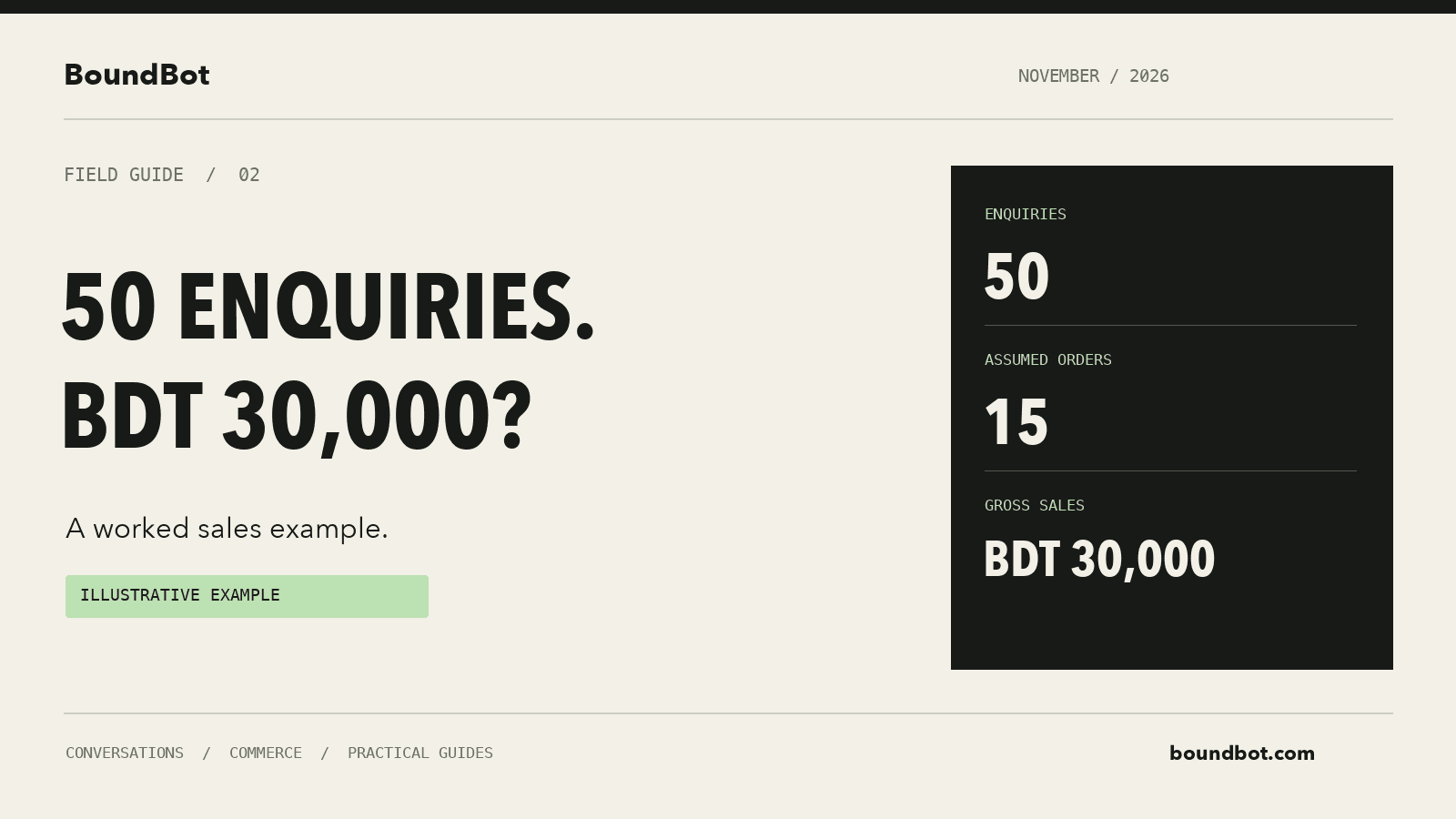
Hypothetical example overview. Illustrative sales calculation showing 50 enquiries, 15 assumed orders, and BDT 30,000 in hypothetical gross sales.
Make the first reply useful enough to move the conversation
A quick “Hello, how can we help?” adds little when the customer has already asked whether a product is available in blue.
Answer the question first when you have reliable information. Then ask for the one detail needed to continue. For example: “The blue option is listed in our current catalog. Which size would you like us to check?”
Keep uncertainty visible. If you cannot confirm the quantity or delivery timing, say what you need to check and who will follow up.
If you use a bot, give it the same approved information your team uses. BoundBot’s knowledge base guide explains its supported sources. Choose the source that fits the information, then maintain it when the offer changes.
Ask for details in the order the customer needs them
An interested buyer may still need to understand the product before sharing an address and phone number.
Start with the decision: which product, variant, or service do they need? Confirm the current price and relevant terms. Collect the details required to complete the order when the customer is ready for that step.
This also makes your team’s work easier to follow. A conversation should have a clear next action rather than a long form dropped into the chat without explanation.
For service enquiries, the next step may be a quote or a booking request instead of an immediate purchase. Measure that stage separately so a request for information does not become a completed sale in your report.
Give unfinished conversations an owner
Two people seeing a message does not tell you who will answer it. Decide who is responsible for each conversation that needs another action.
A small team can keep this simple. One person checks new enquiries during a defined period. Another handles stock checks, delivery questions, or exceptions. At handover, record what the customer needs and when the next answer is due.
Follow-up should stay useful and appropriate for the channel. If someone is waiting for a confirmed size, return with that information. Respect opt-outs and the channel’s messaging rules instead of sending repeated prompts to everyone who once showed interest.
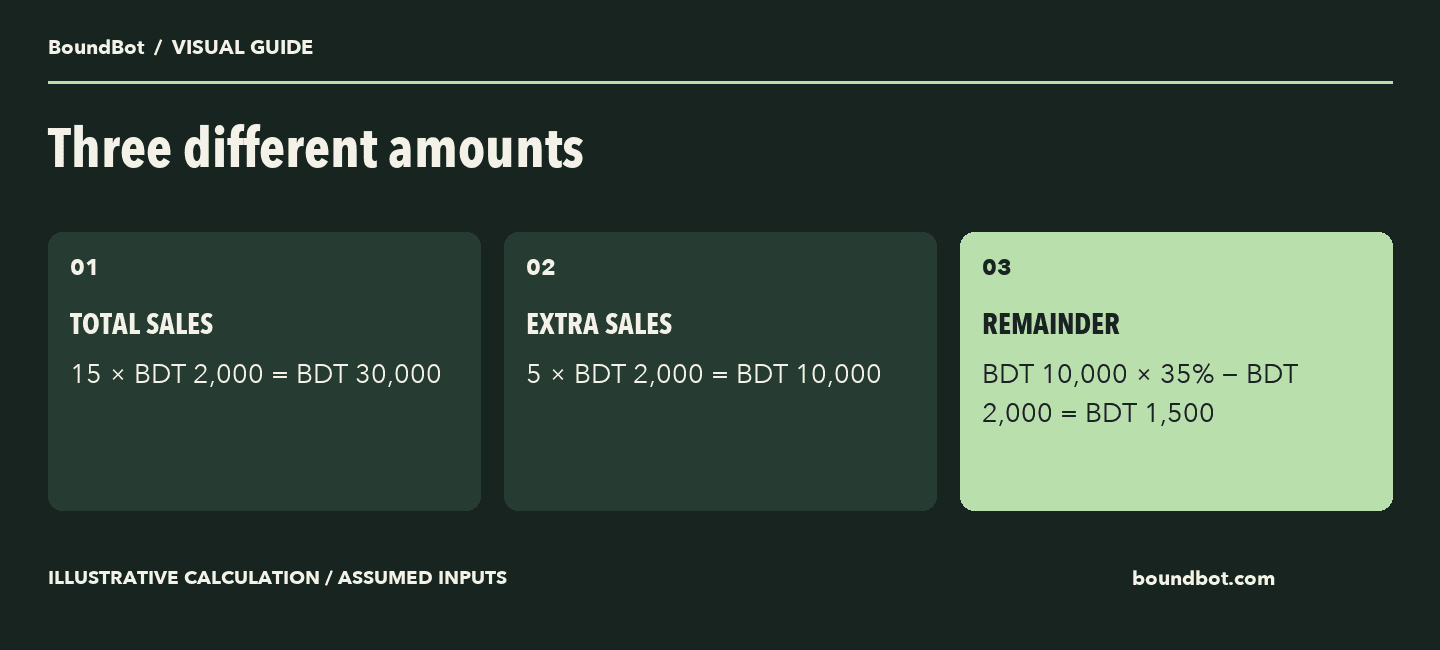
Hypothetical example. Total sales, incremental sales, and the remainder after selected costs are different measures.
Separate total sales from extra sales
Suppose the shop’s baseline was 10 completed orders from 50 enquiries, worth ৳20,000. In the improved scenario, 15 orders are worth ৳30,000.
The difference is five orders and ৳10,000 in gross sales. It would be misleading to describe all ৳30,000 as additional revenue created by a new tool or reply process.
Even the ৳10,000 difference needs care. A different offer, better stock availability, or a change in customer traffic could contribute. Compare similar periods or run a controlled test when you want stronger evidence about what caused the change.
Record the improvement you observed and the conditions around it. That is more useful for your next decision than assigning every sale to the newest change.
Work out what remains after variable costs
Now assume the extra five orders have a 35% contribution margin after the variable costs included in your calculation. The extra ৳10,000 in gross sales would contribute ৳3,500 before additional campaign costs and other overheads.
If the campaign and messaging changes cost an extra ৳2,000, the remainder would be ৳1,500 before any costs not already included.
৳10,000 × 35% − ৳2,000 = ৳1,500.
Be explicit about your inputs. Product cost, packaging, payment charges, delivery subsidies, cancellations, returns, and staff effort can change the result. Do not subtract a cost twice, and do not leave it out because it is paid through a different account.
For cash-on-delivery orders, keep order value separate from collected sales. A placed order can still be canceled or returned before you receive the money.
The hypothetical contribution calculation
Swipe to view all columns →
| Step | Calculation | Amount |
|---|---|---|
| Additional gross sales | 5 assumed extra orders × ৳2,000 | ৳10,000 |
| Contribution before extra campaign cost | ৳10,000 × assumed 35% margin | ৳3,500 |
| Extra campaign and messaging cost | Assumed additional spend | −৳2,000 |
| Remainder before other excluded costs | ৳3,500 − ৳2,000 | ৳1,500 |
Build a weekly record you can trust
Track the post or campaign, unique enquiry, product, responsible person, order reference, outcome, and collected value. A spreadsheet is enough if it stays consistent and private.
For website traffic, UTM campaign parameters help identify where a visit came from. For event measurement, Google distinguishes a lead request from a completed purchase. Those events require the appropriate implementation; they do not appear just because a chat widget is installed.
In BoundBot, use the Leads and Orders pages to review the records your configured workflows create. Reconcile the outcome with the system where fulfillment and payment are actually confirmed.
After a week, choose one problem to fix. It might be incomplete delivery answers or conversations left without an owner. Make the change, then compare the next set of outcomes with the same definitions.
If you need new content to bring those conversations in, start with our November social media post ideas and adapt the examples to the offer you can fulfill.
Frequently asked questions
Is a 30% enquiry-to-order rate a good target?
It is an assumed input in this example. Establish your own baseline using a clear definition of a buying enquiry, then look for improvements you can measure consistently.
Does ৳30,000 in sales mean ৳30,000 in profit?
No. Sales value comes before the costs of supplying and operating the business. Check collected revenue, variable costs, campaign costs, and overheads separately.
Can I count every unfinished chat as recoverable revenue?
Treat unfinished chats as opportunities to investigate. Some people will not buy, even with a helpful answer. Count completed outcomes rather than assuming the entire open pipeline will convert.
Where should a small business begin?
Review ten unfinished buying conversations. Identify one repeated obstacle, give the next action an owner, and check whether more customers reach a completed outcome.
LAUNCH THE AGENT. KEEP THE HUMAN CONTROL.
START FREE, CONNECT A CHANNEL, AND SHIP YOUR FIRST BOUNDBOT IN MINUTES.