
7 Customer Messaging Mistakes That Can Stall Sales: A ৳18,000 Example
Find seven messaging mistakes that leave buying enquiries unfinished. A hypothetical BDT 18,000 example shows how to separate demand from revenue.
10 Nov 2026•8 min read

SEO & Content Marketing Specialist

A buyer asks about a size. Another wants the delivery total. A third is waiting for someone to confirm what comes in the package.
None of these conversations looks dramatic on its own. But when several sit unfinished, it becomes difficult to understand how much demand is waiting and what your team should do next.
Consider a hypothetical November campaign with 12 open buying enquiries. If each person were to complete a ৳1,500 order, the combined gross order value would be ৳18,000. That is a planning scenario, not collected revenue or a claim that all 12 people will buy.
The useful next step is to find the obstacle in each conversation. Here are seven customer messaging mistakes to look for.
Spot the seven mistakes quickly
Swipe to view all columns →
| Mistake | What to inspect | Useful correction |
|---|---|---|
| Unhelpful quick reply | The original question remains unanswered | Answer the known question first |
| Conflicting price | Post, catalog, and reply differ | Maintain one approved current offer |
| Too much data requested | A basic question triggers a long form | Ask what the next step needs |
| No next owner | A check has no responsible person | Assign the check and review time |
| Bot continues during takeover | Human and AI replies conflict | Use the auto-reply control |
| Duplicate opportunities | One buyer is counted several times | Count unique purchase opportunities |
| Requests called sales | Demand is reported as revenue | Reconcile the transaction stage |
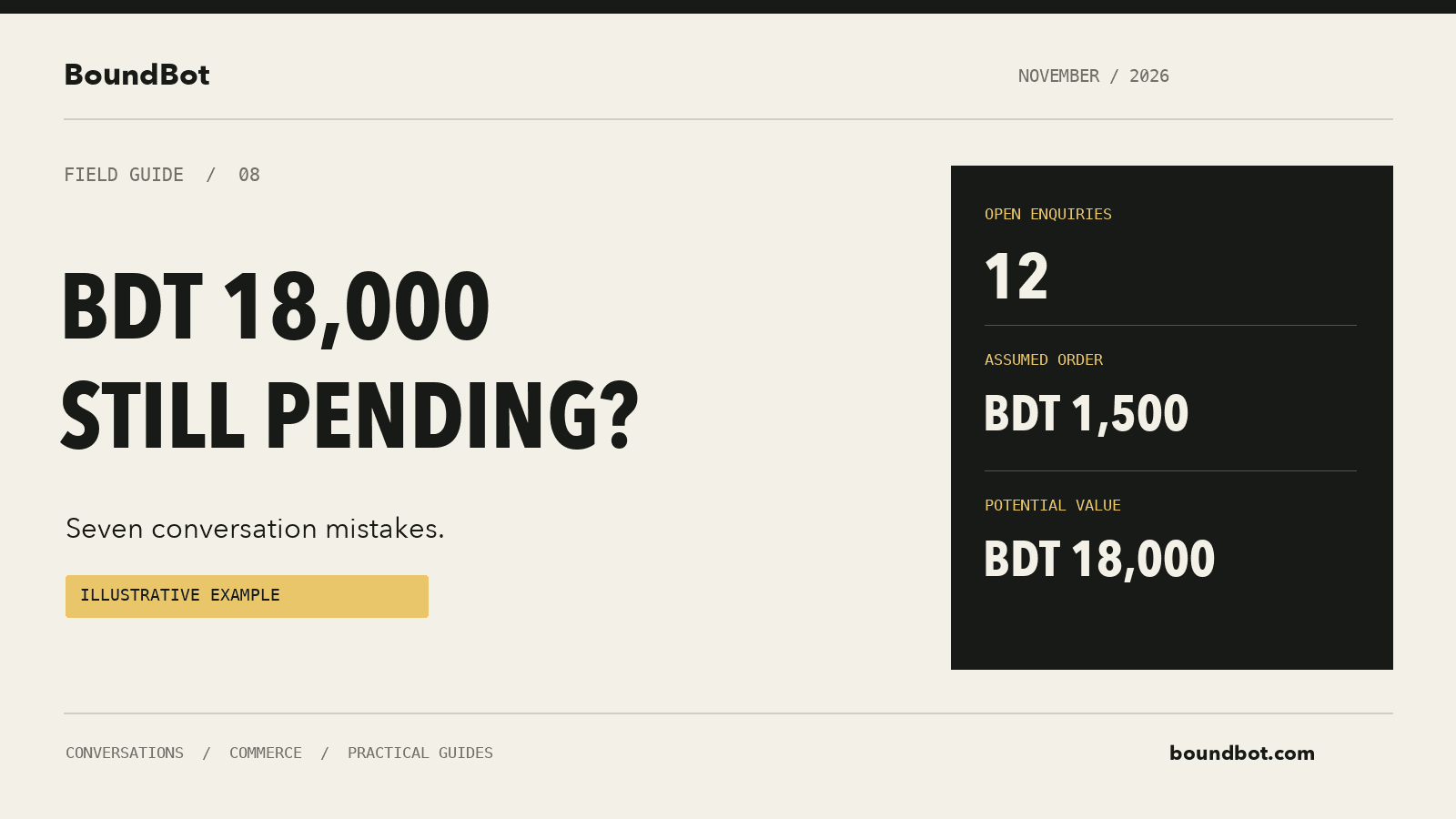
Hypothetical example overview. Illustrative diagram of unfinished buying conversations and BDT 18,000 in hypothetical potential order value.
1. Replying quickly without answering the question
A customer asks whether an item comes in a particular size. The answer says, “Thanks for contacting us. Please tell us how we can help.”
The reply arrived, but the work did not move forward.
Read the question before selecting a saved response or checking an automated answer. If the information is known, answer it. If a detail is missing, ask for that detail. If a check is required, explain the next step.
During a review, distinguish first response from first useful response. This can reveal why an inbox looks active while customers keep repeating themselves.
For the 12-enquiry example, record how many people received the answer they needed. Do not assume that a sent message means the obstacle has been removed.
2. Giving a price that differs from the current offer
The post shows one price. A saved reply shows another. The assistant has information from a previous promotion.
Now the customer has to decide which answer to trust.
Choose a source of truth for the active offer. Review product prices, variant prices, delivery conditions, and any bundle terms before the campaign begins. Assign someone to update the affected places when the offer changes.
BoundBot’s product catalog guide describes product and variant pricing fields. Whatever system you use, verify the answer against the specific item the customer is considering.
If you have already sent an incorrect price, correct it clearly. Do not allow the conversation to continue with two unexplained totals.
3. Asking for too much information before helping
Someone asks a basic product question and receives a request for their name, phone number, full address, preferred payment method, and order details.
Those details may become necessary later. They do not all help answer the first question.
Collect information in the order the task requires. Establish the product and the customer’s need. Explain the relevant price and conditions. Ask for fulfillment details when the customer chooses to proceed.
For a quote, collect the information needed to prepare the quote. For private account support, use the appropriate identity checks before revealing account information.
The point is to make every request understandable. The customer should know what the detail is needed for and what happens after they provide it.
4. Leaving the next action without an owner
“We will check” can become the last message when no one is assigned to do the check.
Before sending that promise, decide who will verify the information and how the answer returns to the customer. Keep an expected time internally, and communicate a realistic expectation when appropriate.
A small handover record is enough to start: what is needed, who owns it, and when it should be reviewed.
In the hypothetical enquiry review, a stock check and a delivery exception are different tasks. Grouping both as “pending” may hide the person or information needed to finish them.
If you are working as a pair, use our small-business messaging guide to choose a tool, then define the ownership process your team will follow inside it.
5. Letting the bot continue after a person takes over
A customer explains a complaint to a teammate. The assistant interrupts with a product recommendation or repeats a policy the person is already reviewing.
This can make the conversation harder to follow at the moment it needs clarity.
Define the handoff behavior and test it. In BoundBot, use the per-conversation auto-reply control when you need the bot to stop; the Inbox guide explains manual intervention and muting.
The person taking over should understand the earlier discussion before replying. A summary can help, but review the relevant messages when a decision depends on their exact meaning.
Return the conversation to automation only when that is appropriate for the request. The customer should have a coherent path through the issue.
6. Counting the same buyer as several opportunities
A person asks on your website and later sends the same question through Messenger. If both are counted as separate potential orders, the pipeline is overstated.
Keep a consistent definition of a unique buying enquiry. Link records only when you have a reliable basis to identify the same purchase opportunity. Do not assume that similar names alone establish a match.
Also check what your messaging tool does automatically. A shared workspace does not, on its own, prove that all channel identities are merged.
In our example, the 12 enquiries must represent 12 distinct opportunities for the ৳18,000 scenario to make sense. If three are repeats of other enquiries, the same calculation using nine opportunities becomes ৳13,500.
That is why a clean count matters before discussing money.
7. Reporting requests as completed sales
An order request can be incomplete. A confirmed order can be canceled. A dispatched cash-on-delivery order can return without collected payment.
Use separate stages for the events that matter in your business. Preserve the difference between enquiry value, placed order value, completed fulfillment, and collected revenue.
The Leads and Orders documentation explains how BoundBot displays captured records. Reconcile those records with the fulfillment and payment systems that confirm the final outcome.
If you use website analytics, Google’s recommended events also distinguish a lead request from a purchase. Apply the right event to the right stage rather than assigning a sale whenever someone opens a chat.
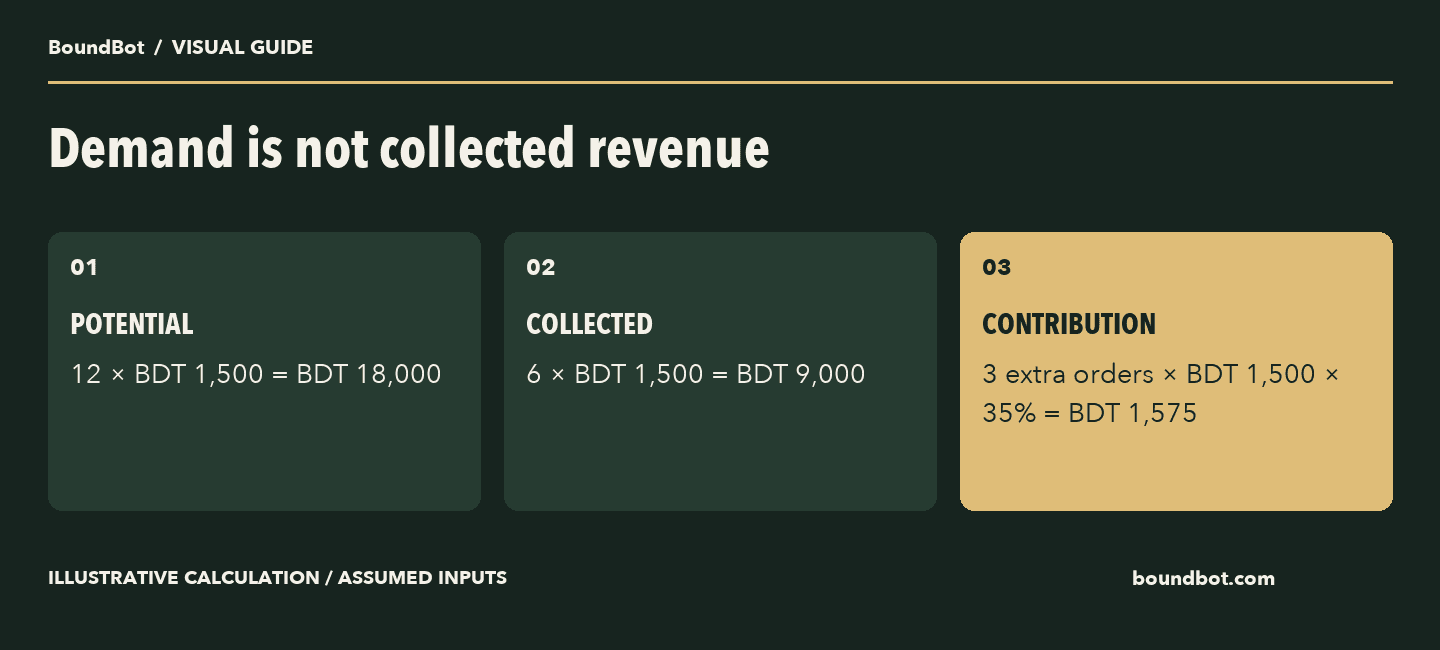
Hypothetical stages and assumptions. These amounts must not be reported interchangeably.
Put the ৳18,000 example into perspective
Suppose the review of those 12 distinct enquiries leads to six completed orders at ৳1,500 each. Collected sales would be ৳9,000 if all six are paid and there are no later adjustments.
You would still need a comparison to estimate how many of those orders were additional. Some customers may have bought without the process change.
If, as a separate assumption, three of the six orders were incremental, that would represent ৳4,500 in extra gross sales. At a 35% contribution margin, those orders would contribute ৳1,575 before additional costs outside that margin.
3 × ৳1,500 × 35% = ৳1,575.
Keep each step visible. The initial ৳18,000 scenario is potential gross order value. The ৳9,000 is the hypothetical collected outcome. The ৳1,575 depends on assumptions about incremental orders and margin.
Keep the hypothetical money figures distinct
Swipe to view all columns →
| Measure | Amount | Condition |
|---|---|---|
| Potential gross order value | ৳18,000 | All 12 unique enquiries buy at ৳1,500 |
| Hypothetical collected sales | ৳9,000 | 6 paid completed orders with no adjustments |
| Assumed extra gross sales | ৳4,500 | 3 of those orders assumed incremental |
| Assumed contribution | ৳1,575 | 35% margin, before extra excluded costs |
Review ten conversations before changing the whole system
Choose ten recent unfinished buying conversations. For each, identify the last question, the answer given, the next action, the owner, and the eventual outcome where known.
Look for a repeated obstacle. Fix that obstacle first, whether it is an outdated delivery answer, an unclear price, or a handover without an owner.
Then review another comparable group using the same definitions. Record changes in product availability or offers so they remain part of the explanation.
A small review can give your team a specific next action. You can then decide whether the solution needs better information, a clearer process, or a change in the messaging tool.
Frequently asked questions
Is an unfinished enquiry the same as a lost sale?
No. It is a conversation to investigate. Some people will not buy regardless of the response, and some may complete the purchase through another route.
Can faster replies solve all these problems?
Response speed is one part of the experience. The answer also needs to be correct, useful, and followed by an owned next step when more work is required.
Should I chase every open conversation?
Follow up when there is a useful, appropriate reason, such as returning with information the customer requested. Respect opt-outs and the rules of the messaging channel.
Which number should I report as revenue?
Use the definition appropriate to your accounting and reporting system. Keep potential demand, orders, collected payment, cancellations, and refunds distinguishable so the report can be reconciled.
LAUNCH THE AGENT. KEEP THE HUMAN CONTROL.
START FREE, CONNECT A CHANNEL, AND SHIP YOUR FIRST BOUNDBOT IN MINUTES.