AI Agent Platforms Compared: Zapier, Make, Voiceflow, Dify, Flowise & More
Not all AI agent platforms work the same way. This breakdown covers the leading tools — Zapier, Make, Voiceflow, Dify, Flowise, and BoundBot — so you can pick the right one without wasting time on the wrong stack.
18 Aug 2026•6 min read
SEO Content Writer
The AI Agent Platform Landscape Is Crowded — Here's How to Read It
The AI Agent Platform Landscape Is Crowded
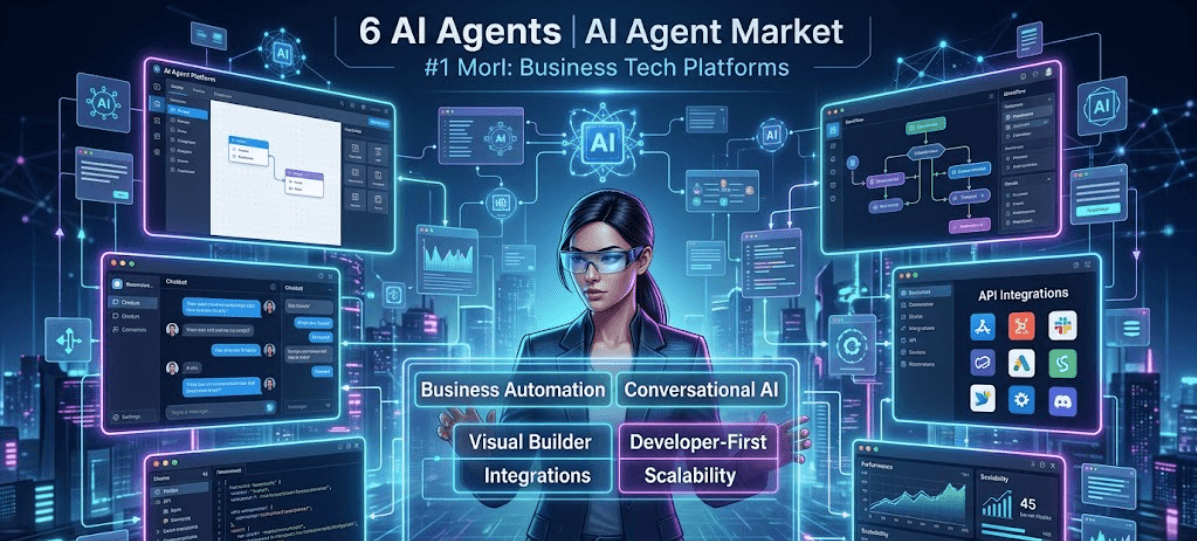
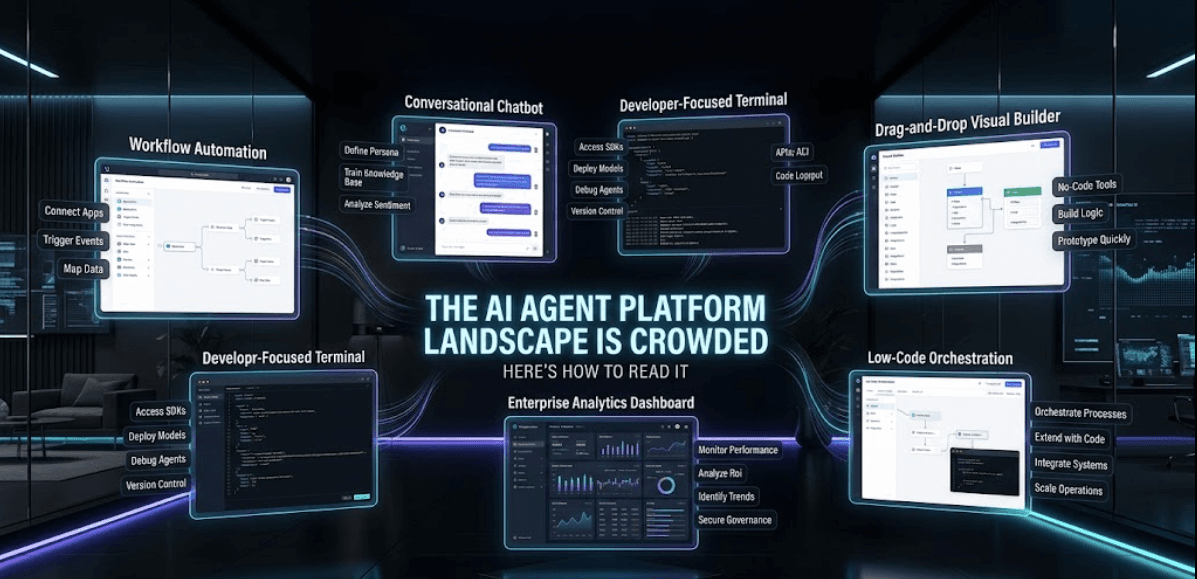
Every platform promises to let you "build AI agents without code." But the tools serve very different needs. Some are built for business automation. Others for conversational agents. Some prioritize visual builders; others lean developer-first.
This comparison breaks down six platforms based on what they actually do, not just their marketing copy.
Zapier: Best for Business Workflow Automation at Scale
Zapier connects more than 9,000 apps and targets teams that need automation across business tools such as Gmail, Slack, Salesforce, and HubSpot without waiting on engineering.
What makes it stand out:
- Plain English workflow building — describe what you want, Zapier figures out the connections
- MCP support for AI assistants like Claude and ChatGPT, plus an SDK for developer teams
- Enterprise governance: endpoint-level action restrictions, managed connections, domain restrictions, and a single audit trail across every AI call
- AI Guardrails that can detect PII, prompt attacks, and toxic content before downstream actions run
- Enterprise model controls, including support for routing eligible AI workloads through Amazon Bedrock
Zapier also includes a chatbot builder, AI agents, and a Tables/Forms/Canvas product suite — making it closer to a full AI operations platform than a simple integration tool.
Best for: Business teams, operations, CRM automation, lead qualification, IT support, enterprise governance.
Make: Best for Visual Workflow Builders Who Need Flexibility
Make (formerly Integromat) takes a canvas-first approach. Teams visually connect modules, AI agents, and deterministic steps across more than 3,000 apps.
Key features:
- Make Grid: a live map of your entire automation landscape across agents, apps, and workflows
- AI Agents built directly on the canvas with step-by-step logs and adaptive decision-making
- MCP Server and Client support for connecting AI to real business actions
- More than 3,000 app integrations and 30,000 actions across the wider Make platform
- Visible reasoning, reusable agents, manual approvals, and stop conditions for operational control
Make is particularly strong for agencies and operators who need to orchestrate multiple AI workflows simultaneously and want full visibility into what's running.
Best for: AI agencies, marketing automation, operations teams, visual builders, multi-step complex logic.
Voiceflow: Best for Conversational AI and Customer Support Agents
Voiceflow is purpose-built for customer experience. It lets teams design, test, deploy, and monitor AI agents across chat and voice — without rebuilding everything when requirements change.
What it offers:
- A global prompt system that shapes agent behavior across every conversation turn
- Playbooks (goal-based agentic conversations) alongside deterministic workflows for predictable routing
- Omnichannel deployment: web, phone, and custom interfaces via API
- LLM-powered evaluations: resolution rate, deflection, CSAT, and custom metrics
- Flexible model choice across major providers, with API access for additional models
- Enterprise controls including SSO, permissions, protected API secrets, and conversation visibility
Voiceflow’s strongest fit is customer-facing conversational automation where teams need the same agent logic across chat, voice, and connected business systems.
Best for: Customer support teams, SaaS companies, enterprises building voice and chat agents, CX leaders.
Dify: Best for Building Production-Ready AI Applications
Dify is an open-source platform combining agentic workflows, RAG pipelines, model integrations, and observability in one place. Its GitHub project has more than 140,000 stars and supports cloud, VPC, and self-hosted deployment.
Core capabilities:
- Visual workflow builder with nesting support — workflows inside workflows
- Native MCP integration and the ability to publish as a universal MCP server
- A plugin marketplace for models, tools, data sources, triggers, and agent strategies
- Workflow testing, versioning, traces, and recovery paths for production operation
- Supports teams from startups validating MVPs to enterprises running AI across departments
Best for: AI startups, developers building SaaS products, enterprises needing RAG pipelines and API-connected agents.
Flowise: Best Open-Source Platform for Developers
Flowise is an open-source visual platform for building LLM workflows and AI agents. It can run in the cloud or on your own infrastructure and provides Assistant, Chatflow, and Agentflow builders for different levels of complexity.
Swipe to view all columns →
| Builder Type | Use Case |
|---|---|
| Assistant | Beginner-friendly chatbots with RAG |
| Chatflow | Single-agent systems with tool calling |
| Agentflow | Multi-agent orchestration and complex workflows |
Standout features:
- Human-in-the-Loop (HITL) for reviewing agent actions before execution
- Full execution traces with OpenTelemetry and Prometheus support
- TypeScript and Python SDKs, REST API, embedded chat widget
- Horizontal scaling via message queues and workers
- On-prem and cloud deployment options
Pricing starts free (2 flows, 100 predictions/month), with paid plans from $35/month for individuals up to $65/month for teams needing workspaces, admin roles, and priority support.
Best for: Developers, technical teams, companies wanting self-hosted AI infrastructure, open-source builders.
BoundBot: Best for Multi-Channel Customer Support Without Complexity
BoundBot is a newer entrant focused on grounded AI agents across six channels — WebChat, WhatsApp, Messenger, Telegram, Slack, and Discord — from one dashboard.
What differentiates it:
- Grounded answers using website pages, FAQs, uploaded files, Google Sheets imports, and product catalogs
- Keyword rules with exact, contains, or regex matching for deterministic responses
- Unified inbox with live human takeover and escalation workflows
- Lead capture built into the conversation flow (no separate form needed)
- Free plan with 750 monthly credits (about 75 standard AI replies)
It's a compact stack — AI agent, automation workflows, human handoff, and multi-channel deployment — inside one tool. Particularly well-suited for freelancers, small SaaS teams, and community operators.
Best for: Startups, freelancers, e-commerce support, Discord/Telegram community bots, lean support teams.
Swipe to view all columns →
| Platform | Best For | No-Code | Open Source | Multi-Channel |
|---|---|---|---|---|
| Zapier | Business automation, enterprise | ✓ | ✗ | ✓(via integration) |
| Make | Visual workflow builders, agencies | ✓ | ✗ | ✓ |
| Voiceflow | Customer support, voice agents | ✓ | ✗ | ✓ |
| Dify | AI SaaS, RAG pipelines | partial | ✓ | ✓ |
| Flowise | Developers, self-hosted | partial | ✓ | ✓ |
| BoundBot | Lean support, multi-channel chat | ✓ | ✗ | ✓ |
Which Platform Should You Start With?
- Non-technical business user → Zapier or Make
- Building a customer support bot → Voiceflow or BoundBot
- Launching an AI product or SaaS → Dify
- Developer who wants full control → Flowise
- Small team needing multi-channel chat fast → BoundBot
- Enterprise with governance requirements → Zapier or Voiceflow
The tools above aren't interchangeable — each has a distinct architectural decision baked in. Pick based on where your team spends time and where your users actually are.
LAUNCH THE AGENT. KEEP THE HUMAN CONTROL.
START FREE, CONNECT A CHANNEL, AND SHIP YOUR FIRST BOUNDBOT IN MINUTES.