How Startups Can Automate Customer Support Using AI Agents
Automate customer support with AI agents. Reduce response time, answer FAQs instantly, and provide 24/7 help using modern AI support tools.
12 Mar 2026•5 min read

SEO & Content Marketing Specialist

Why Startups Need to Automate Customer Support as They Grow
In the early days of a startup, customer support usually feels manageable. A few emails here, a couple of chat messages there. Founders or small teams can respond easily. But as products grow, many startups start looking for ways to automate customer support so they can handle increasing requests without expanding their team.
But things change quickly once the product starts gaining traction.
More users means more questions. New customers ask how to get started, existing users report issues, and many want quick clarification before making a purchase. A large portion of these requests are repetitive, yet each one still needs a clear and timely response.
For startups with limited support staff, this creates a growing workload. According to research from Zendesk, over 70% of customers expect immediate help when contacting support, especially through chat or messaging platforms.
This is why many startups are turning to AI-powered support automation. By using intelligent agents that can answer common questions and assist users instantly, startups can handle support requests more efficiently while keeping their team focused on building the product.
What Is Customer Support Automation
As startups grow, the number of support requests grows with them. Many of these requests, however, follow the same pattern: questions about pricing, onboarding, product features, or simple troubleshooting. Handling these manually can quickly overwhelm a small team. This is why many companies look for ways to automate customer support.
Customer support automation uses software systems to manage routine customer inquiries without constant human involvement. Instead of replying to every message individually, automated systems can provide instant answers, guide users through common issues, and route complex problems to a human agent when needed.
Most automation systems rely on a structured knowledge base. This includes FAQs, help center articles, product documentation, and troubleshooting guides. When a user asks a question, the system retrieves relevant information from these sources and delivers a response in seconds.
Recent advances in artificial intelligence have significantly improved this process. Traditional chatbots relied on scripted rules and keyword triggers. Modern AI agents can understand natural language, search internal company data, and generate context-aware responses.
For example, an AI support agent can:
- explain product features or pricing plans
- guide users through onboarding steps
- help troubleshoot common problems
- escalate complex issues to human support
For growing startups, this makes it much easier to automate customer support while keeping response times fast and support teams focused on more complex work.
How AI Agents Help Automate Customer Support
AI agents are changing how companies manage customer support. Unlike older chatbots that rely on fixed scripts, modern AI systems can understand natural language and respond to customer questions more intelligently. This makes it easier for startups to automate customer support without relying on large support teams.
When a customer sends a message, the AI agent analyzes the request, identifies the intent, and retrieves relevant information from the company’s knowledge sources. These sources often include FAQs, help center articles, and product documentation. Because the system can search this information instantly, customers receive accurate answers within seconds.
Compared to traditional chatbots, AI agents provide a more flexible support experience:
Swipe to view all columns →
| Feature | Traditional Chatbots | AI Agents |
|---|---|---|
| Responses | Script-based | Context-aware responses |
| Understanding | Keyword matching | Natural language understanding |
| Knowledge access | Limited answers |
For startups, this capability helps automate repetitive questions while keeping support fast, consistent, and available around the clock.
Common Customer Support Tasks Startups Can Automate
Not every support request requires a human response. In fact, many questions customers ask follow predictable patterns. By identifying these patterns, startups can automate a large portion of their support workload using AI customer support systems.
Here are some of the most common tasks startups can automate:
- Answering frequently asked questions: Questions about pricing plans, account setup, product features, or subscription details appear repeatedly. An AI chatbot for support can provide instant answers using the company’s knowledge base.
- Guiding users through onboarding: New customers often need help setting up accounts, connecting integrations, or understanding key features. AI support agents can walk users through these steps and provide helpful resources automatically.
- Basic troubleshooting assistance: Many support tickets involve simple issues such as login problems, configuration questions, or common errors. Automation can guide users through troubleshooting steps before escalating the issue.
- Routing and organizing support tickets: Modern AI helpdesk systems can categorize incoming messages and direct them to the correct team when human intervention is required.
By automating these routine interactions with the right support automation tools, startups can reduce ticket volume, improve response times, and allow support teams to focus on more complex customer needs.
AI Agents vs Traditional Chatbots
Traditional chatbots were one of the first tools used to automate customer support. They typically rely on predefined rules or keyword triggers to respond to user questions. While this approach works for simple interactions such as answering FAQs or directing users to help articles, it often struggles when conversations become more complex.
AI agents take a more advanced approach. Instead of following fixed scripts, they can understand natural language, analyze user intent, and retrieve information from company knowledge sources. This allows them to generate more relevant and contextual responses.
The difference becomes clear when handling real support scenarios. A chatbot might only recognize specific commands, while an AI agent can interpret a question, search documentation, and guide the user toward a solution.
As customer expectations grow, many companies are moving beyond rule-based bots toward AI support agents that can automate customer support more intelligently. If you want to explore this shift in more detail, read our guide on The Evolution of AI Agents: Why Chatbots Aren’t Enough in 2026.
How Startups Can Automate Customer Support
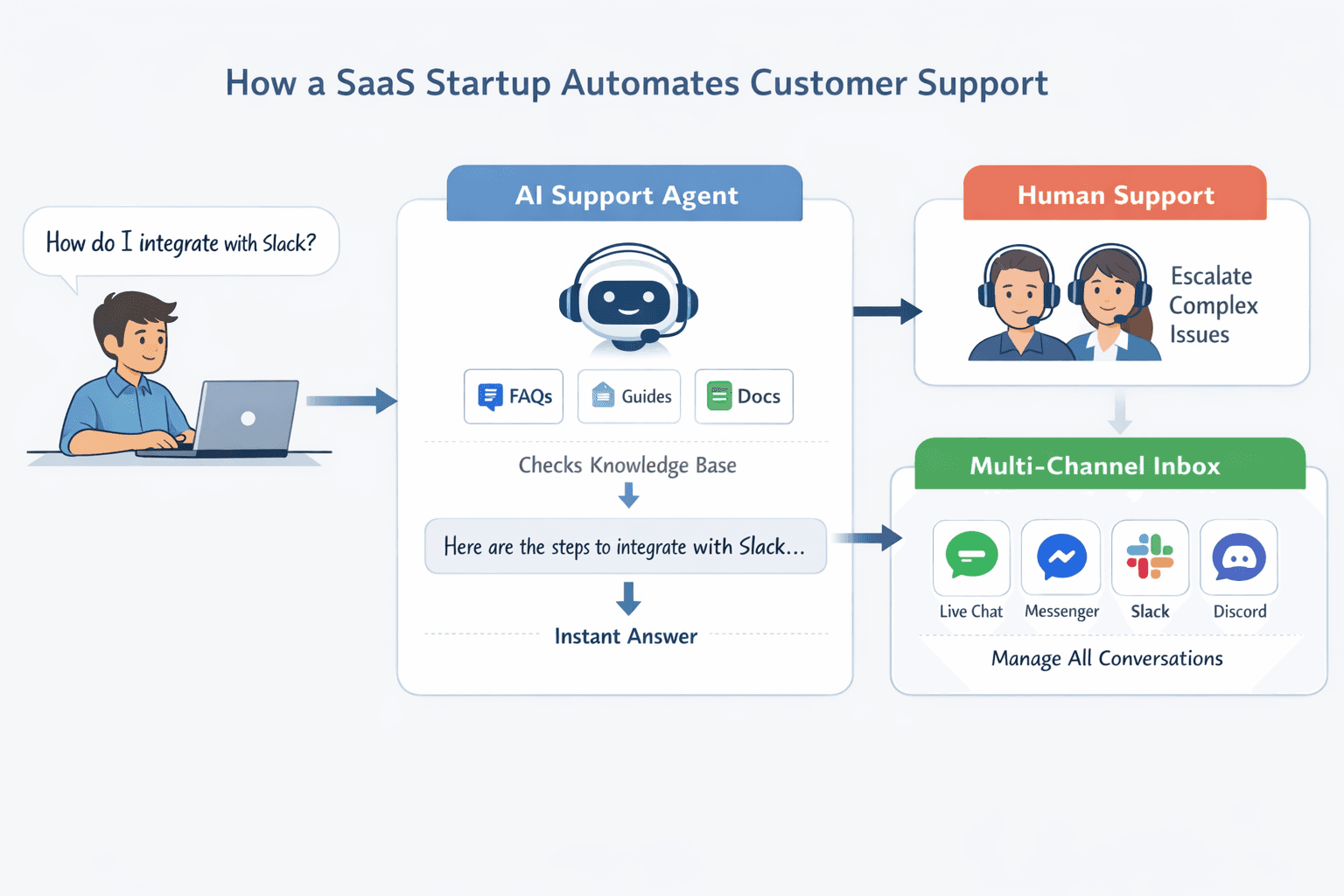
AI support agent workflow showing how startups automate customer support
Automating support usually begins by understanding where support teams spend most of their time. As startups grow, many incoming requests tend to repeat the same themes such as account setup, pricing questions, feature explanations, or simple troubleshooting.
The first step is identifying these patterns. Reviewing past support conversations often reveals which questions appear most frequently. Once these patterns are clear, startups can organize the answers into structured resources such as FAQs, help center articles, or onboarding guides.
These resources become the foundation for customer support automation. Modern AI support agents can use this information to answer routine inquiries instantly while more complex issues are routed to human support when necessary. This allows teams to focus on higher value work rather than repeatedly answering the same questions.
Automation works best when integrated into the channels customers already use. Many startups deploy AI customer support through website chat, messaging platforms, or community tools so users can get help without leaving the conversation.
With BoundBot, this process becomes much simpler. You can upload FAQs, website content, product documentation, or support files, and the AI learns directly from those sources. Once trained, the AI agent can respond to customer questions across web chat, Messenger, Telegram, Slack, or Discord, all managed from a single inbox. This allows startups to automate customer support quickly while keeping answers accurate and consistent.
Benefits of Automating Customer Support for Startups
For startups, support demand often grows quickly as new users join the product. Automating parts of the support workflow helps teams manage this growth more efficiently. By combining knowledge bases, AI customer support, and modern support systems, startups can deliver reliable assistance while keeping operations lean.
Faster Customer Responses
Customers expect quick answers when they reach out for help. Automation allows support systems to respond instantly to common questions such as onboarding steps, feature explanations, or pricing details. Faster responses improve the overall user experience and help prevent small issues from becoming bigger problems.
Reduced Ticket Volume
A large share of support requests involve repetitive questions. With customer support automation, these routine inquiries can be resolved automatically before they reach the support queue. This reduces the number of tickets teams need to handle manually and allows them to focus on more complex customer needs.
24/7 Customer Support Availability
Unlike traditional support teams that operate during limited business hours, automated systems can provide 24/7 customer support. AI support agents remain available across different time zones, ensuring users can get assistance whenever they need it.
Scalable Support Operations
As startups grow, support demand grows with them. Support automation tools make it possible to handle a larger number of conversations without rapidly expanding the support team, helping startups maintain consistent service as their customer base increases.
Challenges of Automating Customer Support
While automation can significantly improve efficiency, startups should approach it carefully. A thoughtful setup ensures that AI customer support enhances the experience rather than creating frustration for users.
Common challenges include:
- Incomplete knowledge sources: If FAQs, documentation, or help articles are missing important information, AI support agents may struggle to provide accurate answers.
- Over-automation without human fallback: Some issues still require human judgment. Without clear escalation to a support agent, customers may feel stuck in automated conversations.
- Poor system integration: Automation works best when connected to existing tools such as helpdesks, messaging platforms, and product databases. Weak integrations can limit how effectively support requests are handled.
- Initial setup and training effort: Building a reliable automation system requires organizing support documentation and training the AI on company knowledge.
By addressing these challenges early, startups can implement customer support automation in a way that improves response times while maintaining a positive customer experience.
Scale Customer Support Without Scaling Your Team
As startups grow, customer support can quickly become difficult to manage with a small team. Automating routine questions with AI allows startups to respond faster, stay consistent, and focus more time on building better products.
The most effective approach is combining structured knowledge with modern AI support agents that can assist customers instantly while escalating complex issues when needed.
If you're ready to simplify support and handle more conversations without expanding your team, we can help. At BoundBot, our platform lets you train AI agents using your FAQs, website content, and product documentation so you can automate customer support and deliver faster assistance to your users.
Frequently Asked Questions
Q1. How long does it take to set up automated customer support for a startup?
For most startups, the initial setup can be done in a few hours to a few days depending on the size of the knowledge base. Once FAQs and documentation are uploaded, an AI support agent can start answering common questions quickly.
Q2. Can automated support handle complex customer issues?
Automation is best for routine and repetitive questions. When a request requires deeper investigation, the system can automatically escalate the conversation to a human support agent for proper resolution.
Q3. Is customer support automation expensive for early-stage startups?
Many modern startup customer support tools are designed to be affordable and scalable. Startups can begin with basic automation features and expand as their customer base and support needs grow.
Q4. How accurate are AI support agents when answering customer questions?
Accuracy depends on the quality of the knowledge sources used to train the system. When AI agents are trained on reliable FAQs, product documentation, and help articles, they can provide highly relevant and consistent responses.
Q5. What channels can automated customer support work on?
Most modern support automation platforms can operate across multiple channels such as website chat, messaging apps, and community platforms. This allows startups to assist customers wherever they prefer to communicate.
LAUNCH THE AGENT. KEEP THE HUMAN CONTROL.
START FREE, CONNECT A CHANNEL, AND SHIP YOUR FIRST BOUNDBOT IN MINUTES.