SaaS Marketing in 2026: Strategies That Drive Real Growth
Getting new customers is getting harder and more expensive. That’s why keeping the customers you already have matters more than ever. In this guide, you’ll learn 7 simple AI-powered strategies to help retain, grow, scale your business.
18 Apr 2026•5 min read
SEO Content Writer
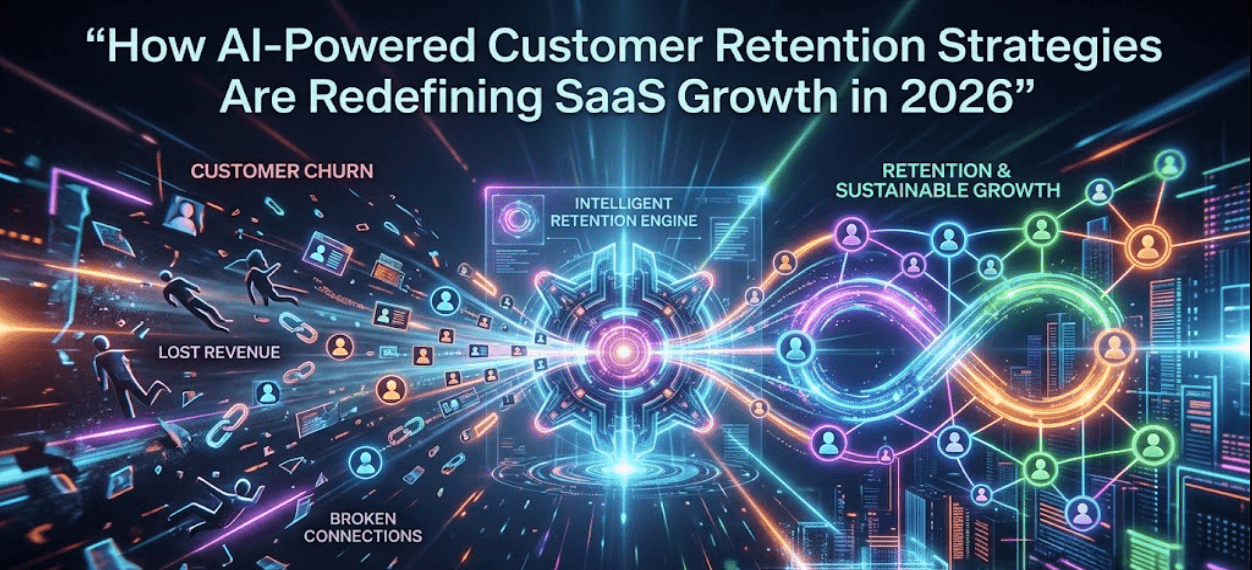
How AI-Powered Customer Retention Strategies Are Redefining SaaS Growth in 2026

Customer retention AI
You spent months acquiring a customer. Sales worked hard. Marketing burned budget. The onboarding team gave it their best shot.
Then, three months later — they're gone.
Losing customers is the silent killer of SaaS growth. Most companies obsess over acquisition while quietly bleeding revenue out the back door. In 2026, with CAC (customer acquisition cost) still rising and buyer attention harder to earn than ever, retaining customers is no longer just a "nice to have" — it's your most important growth lever.
The good news? AI has completely changed what's possible. You no longer have to guess which customers are about to leave. You don't have to send the same generic email to everyone and hope something sticks. AI-powered retention strategies give you the ability to predict, personalize, and act — at scale, in real time.
This guide breaks down exactly how SaaS founders, B2B marketers, and growth teams can use AI to reduce customer turnover, increase lifetime value, and build customer relationships that actually last.
Why Customer Retention Matters More Than Ever in 2026
Let's start with context. Three major shifts have made retention the top priority for SaaS businesses this year:
1. Acquisition costs have exploded: Paid ads are more expensive. Organic reach is harder. The average SaaS company now spends 5–7x more to acquire a new customer than to retain an existing one.
2. Buyers are more demanding: Your users have dozens of alternatives. If your product doesn't deliver ongoing value faster, they'll switch without a second thought.
3. Revenue math now favors retention: A 5% increase in customer retention can increase profits by 25–95% (Bain & Company research). For subscription businesses, net revenue retention (NRR) above 110% is what separates fast-growing companies from struggling ones.
The companies winning in 2026 aren't just great at marketing. They're great at keeping customers through smarter, AI-assisted experiences.
7 AI-Powered Retention Strategies That Actually Work

Customer retention analysis
1. Predict Churn Before It Happens
The biggest advantage AI gives you is foresight. Instead of reacting when someone cancels, you act weeks before they even think about leaving.
AI churn prediction models analyze behavioral signals — login frequency, feature usage, support tickets, billing activity — and flag at-risk accounts automatically. Tools like Gainsight, ChurnZero, and Totango use machine learning to score each customer's health in real time.
What to look for in at-risk customers:
- Drop in weekly active usage (especially a 30%+ decline over 2 weeks)
- Repeated failed actions or support tickets without resolution
- No expansion behavior (not exploring new features or seats)
- Billing hesitation or skipped payment attempts
- Low NPS score combined with low engagement
Once flagged, your customer success team gets a prioritized list every morning. Instead of treating all customers the same, they focus energy where it matters most.
Practical example: A mid-size project management SaaS reduced churn by 22% in one quarter simply by training their customer service team to reach out proactively within 48 hours of any customer's health score dropping below a set threshold. No fancy campaign — just timely, personal outreach triggered by AI data.
2. Personalize the In-App Experience Using Behavioral AI
Generic onboarding kills retention. Most users churn in the first 30 days not because your product is bad, but because they never discovered the value.
AI solves this by tracking each user's behavior and surfacing the right feature, tip, or content at exactly the right moment. This is called contextual in-app guidance, and it's one of the highest-ROI retention investments you can make.
How it works in practice:
Swipe to view all columns →
| User Behavior | AI-Triggered Action |
|---|---|
| Signs up but hasn't connected any data | Show a 60-second setup guide for their use case |
| Uses feature A heavily but never tried feature B | In-app tool tip: "Teams like yours save 3 hours/week using [Feature B]" |
| Hasn't logged in for 7 days | Smart email: "Here's what changed since your last visit" |
| Reaches plan limit 3x in a week | Expansion prompt with ROI framing |
Tools like Appcues, Pendo, and Intercom now offer AI-driven flows that adapt based on user segments and actions — no engineering required for most changes.
3. Build a Product-Led Retention Loop
Product-led growth (PLG) isn't just an acquisition strategy. In 2026, the most successful SaaS companies are using PLG principles to retain customers by making the product itself the reason they stay.
The core idea is simple: Every time a user opens your app, they should discover new value. AI helps make this possible at scale.
The PLG Retention Loop:
- User takes an action in the product
- AI identifies the next best action that deepens engagement
- The product delivers a prompt, reward, or result that creates a "wow" moment
- User returns more frequently and explores more features
- Switching cost increases naturally — they've built workflows inside your product
Notion, Figma, and Linear all do this brilliantly. The product rewards usage with increasing value, making it painful to leave because so much of your work lives inside it.
4. Use AI to Power Your Community-Led Retention Strategy

Collaborative SaaS workspace
Community is the most underrated retention channel in SaaS. When your customers talk to each other, share wins, solve problems together, and build an identity around your product — they don't just stay. They promote.
AI makes community management scalable in ways that weren't possible before:
- Sentiment analysis monitors community discussions and flags negative trends early
- Content recommendation engines surface the most relevant posts and resources to each member
- Auto-tagging and routing helps support questions reach the right expert community member
- Engagement scoring identifies your most active community advocates for referral or ambassador programs
Real example: Canva's community has millions of members. AI helps them surface the right template, tutorial, or discussion to each user based on their design history and skill level. The result is a community that feels personally useful — not a generic forum.
If you don't have a community yet, start small. A Slack group, a Discord server, or even a monthly virtual meetup can create belonging that a product alone cannot.
5. Automate Personalized Re-Engagement Campaigns
Not every churned or disengaged customer is gone forever. Many just got busy, forgot about your product, or never got to the "aha moment."
AI-powered re-engagement goes far beyond the standard "We miss you!" email. Modern tools analyze why a customer disengaged and craft messaging that addresses their specific situation.
Re-engagement campaign framework:
Swipe to view all columns →
| Segment | Likely Reason for Disengagement | AI-Personalized Message Angle |
|---|---|---|
| Never completed setup | Complexity or time constraint | "Finish in 5 minutes — here's your saved progress" |
| Used product, then stopped | Didn't find core value | "Here's how [Company Like Theirs] solved [Their Pain Point]" |
| Churned after price increase | Price sensitivity | "Here's what's new since you left + a special offer" |
| Expired free trial, didn't convert | Wasn't ready yet | "The feature you used most is now improved — try it free" |
Tools like Customer.io, Klaviyo, and BoundBot (for B2C/D2C SaaS), support AI-generated email copy variants that are A/B tested automatically, so you're always improving without manual effort.
6. Implement AI-Driven Customer Success at Scale
Traditional customer success doesn't scale. You can't have a dedicated customer service manager for every customer when you're serving thousands. AI bridges that gap.
The model that's winning in 2026 is called tiered AI-augmented CS:
- High-value accounts get human customer service management assisted by AI-generated health scores, meeting summaries, and next-step recommendations
- Mid-market accounts get a mix of automated touchpoints and human check-ins triggered by AI alerts
- SMB and self-serve accounts get fully automated AI-driven success journeys — in-app, via email, and through product nudges
AI tools for CS teams worth knowing:
- Gong + Salesforce Einstein — analyzes sales and renewal calls to flag risk signals
- Gainsight AI — predicts renewals, flags at-risk accounts, recommends playbooks
- Intercom Fin — AI agent that handles tier-1 support and routes complex issues to humans
- Mixpanel + AI analysis — tracks product engagement and surfaces retention insights automatically
The goal isn't to replace your CS team. It's to make each person on your team 10x more effective by giving them the right information at the right time.
7. Close the Feedback Loop With Continuous AI Analysis
Retention improves fastest when you understand why customers stay and leave. Most companies collect feedback but don't act on it fast enough. AI changes this.
The AI-powered feedback loop:
- Collect signals continuously — NPS, CSAT, in-app feedback, support tickets, review sites
- AI categorizes and themes the feedback automatically (no manual tagging)
- Trends surface in real time — you see a spike in complaints about a specific feature within hours, not weeks
- Your product and customer service teams receive weekly AI-generated summaries with prioritized action items
- Changes are made, communicated to customers, and impact is measured in the next feedback cycle
Tools like Dovetail, Thematic, and even ChatGPT-powered analysis pipelines can automate most of this workflow. The result is a company that truly listens and responds — which customers notice.
Common Mistakes to Avoid
Even with AI tools available, many teams get retention wrong. Here's what to watch out for:
- Automating without empathy: AI-triggered emails that feel robotic or irrelevant damage trust. Always review automated messages with a human eye.
- Measuring the wrong metrics: Focusing on login rates instead of value delivery is a trap. A customer can log in daily and still churn if they're not achieving their goals.
- Over-investing in win-back instead of prevention: It's 5x harder to win back a churned customer than to keep an engaged one. Shift budget upstream.
- Treating all customers the same: Segmentation is the foundation of every good retention strategy. Your enterprise client and your solo founder user need completely different experiences.
- Ignoring expansion revenue: Retention isn't just about stopping churn. It's about growing existing accounts. AI can identify upsell and expansion signals just as well as churn signals.
Future Trends: What's Coming Next
The next 12–18 months will bring even more powerful retention tools. Here's what to keep an eye on:
AI agents for proactive success — Autonomous AI agents will be able to detect a customer struggle, reach out, schedule a call, and suggest product changes — all without a human initiating the process.
Predictive LTV modeling — AI will not just predict who churns, but forecast each customer's 3-year revenue potential, helping teams prioritize investment in the right relationships.
Voice and video AI in CS — AI-analyzed video calls will give customer service teams real-time coaching during customer conversations, flagging risk signals and suggesting responses on the fly.
Hyper-personalized product experiences — The product itself will adapt its UI, feature set, and onboarding based on each user's role, behavior, and goals — without any manual configuration.
Conclusion: Retention Is Your Competitive Market Shield
In 2026, the SaaS companies that win aren't necessarily the ones with the best product launch. They're the ones that keep customers the longest, grow them the fastest, and build relationships that are genuinely hard to replace.
AI gives you the tools to do all of this at scale to predict problems before they become churn, to personalize every touchpoint, and to build a customer experience that earns loyalty instead of just buying it.
Start with one strategy from this guide. Pick the one that addresses your biggest current retention gap — whether that's churn prediction, personalized onboarding, or re-engagement. Build it well, measure it honestly, and expand from there.
The companies that treat retention as a core competency — not an afterthought and will compound their growth in ways their acquisition-obsessed competitors simply can't match.
Frequently Asked Questions (FAQ)
Q: What's the best AI tool to start with for SaaS customer retention?
It depends on your stage. Early-stage startups benefit most from tools like Intercom (for in-app messaging and AI support) or Customer.io (for behavioral email). Series A and beyond should look at Gainsight or ChurnZero for full customer success platform capabilities.
Q: How do I measure if my AI retention strategy is working?
Track these key metrics: Net Revenue Retention (NRR), monthly churn rate, time-to-first-value, product adoption depth (features used per active user), and expansion revenue. Compare month-over-month trends after implementing each strategy — most tools show meaningful impact within 60–90 days.
Q: Can small SaaS teams (under 10 people) actually use AI for retention?
Absolutely. Many of the best AI retention tools, like BoundBot have affordable tiers and don't require a dedicated customer service team to operate. Start with behavioral email automation and one in-app guidance tool — you can manage both with a single marketing or product person spending a few hours per week.
LAUNCH THE AGENT. KEEP THE HUMAN CONTROL.
START FREE, CONNECT A CHANNEL, AND SHIP YOUR FIRST BOUNDBOT IN MINUTES.