
AI Chatbots for Dentists, Clinics, and Medical Practices: A Practical Guide
Build a healthcare chatbot that answers patient questions, books appointments, and knows when something is urgent. Automate everyday workflows like insurance checks and new patient onboarding without overwhelming your staff.
18 Apr 2026•5 min read
SEO Content Writer
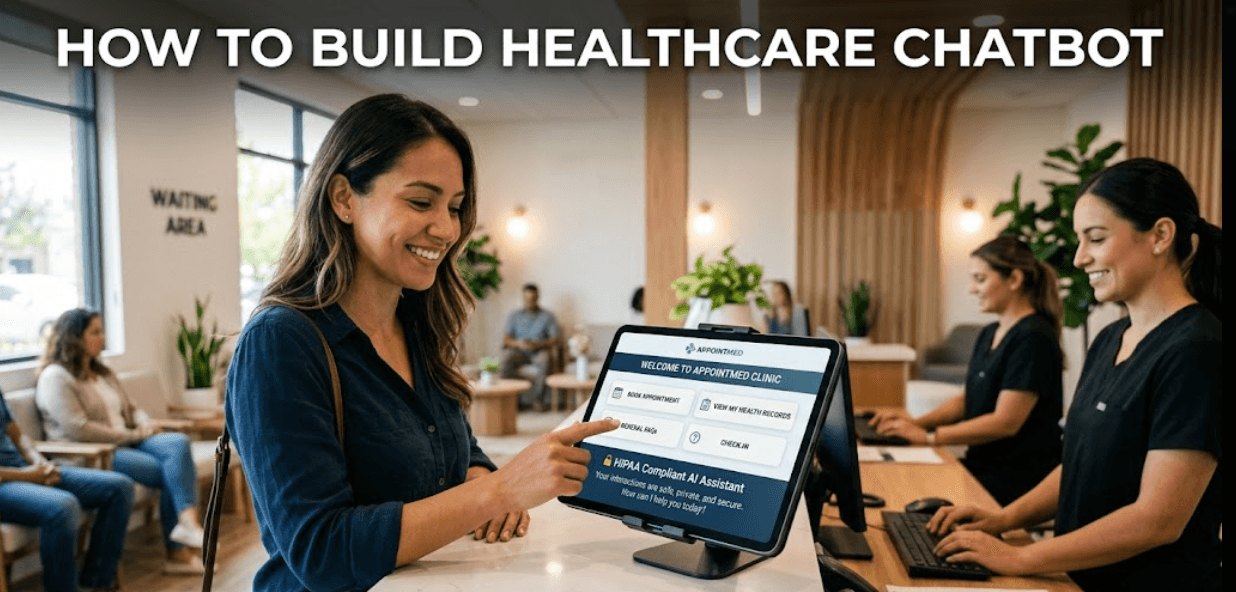
Your Patients Are Online. Is Your Clinic?

Frustrated parent, sick child.
Picture this: It's 11 PM. A worried parent is trying to book a dental appointment for their child. Your clinic is closed. The phone just rings. So they Google another dentist — one with a chat widget that answers instantly.
That patient is gone.
This is happening every single day across thousands of clinics. And the fix is not hiring more front desk staff. The fix is a healthcare AI chatbot.
In this guide, you'll learn exactly how AI chatbots work for dental offices, clinics, and medical practices — and how an AI tools make it simple, safe, and HIPAA-friendly.
What Is a Healthcare AI Chatbot?
A healthcare AI chatbot is an intelligent virtual assistant that talks to your patients automatically — It answers questions, collects patient information, books appointments, and even escalates urgent cases to your staff.
But here's the key difference from old-school chatbots:
Modern AI chatbots are grounded in your clinic's real data. They don't make things up. They generate accurate responses from uploaded documents, session transcriptions, and clinical notes — keeping everything private, HIPAA-compliant, and specific to your practice.
That matters a lot in healthcare, where a wrong answer isn't just risky — it can be dangerous.
Why Clinics and Dental Offices Need an AI Chatbot Right Now
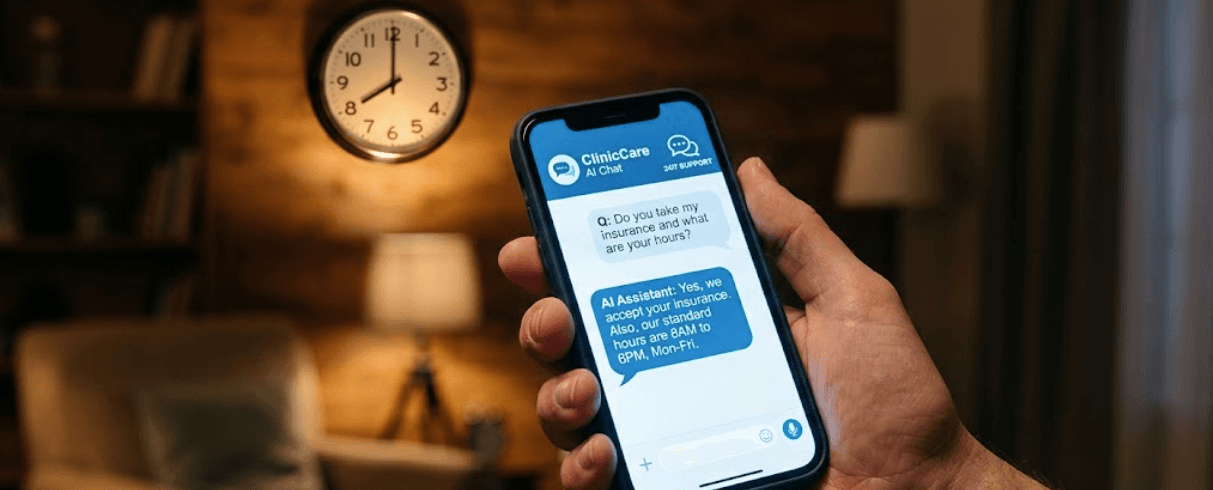
Medical chatbot response
Let's be honest. Running a clinic is expensive and exhausting. Your front desk team spends hours every day answering the same questions over and over:
- "Do you accept my insurance?"
- "What are your hours?"
- "How much does a teeth cleaning cost?"
- "Can I book an appointment online?"
These are important questions — but they don't need a human to answer them every single time. An AI chatbot handles these automatically, 24 hours a day, 7 days a week.
Here's what that means for your practice:
| Problem | Without AI Chatbot | With AI Chatbot |
|---|---|---|
| After-hours inquiries | Missed completely | Answered instantly |
| Repetitive front desk calls | Staff burns out | Fully automated |
| New patient lead capture | Lost if not called back | Captured and saved |
| Insurance verification questions | Manual, time-consuming | Bot handles first pass |
| Emergency escalations | Delayed response | Instant staff alert |
The question is no longer should your hospital or practice use AI. The question is which AI healthcare tool is right for your specific role, your workflow, and your compliance requirements.
Here are the 5 most powerful HIPAA-compliant AI tools for healthcare in 2026:
- BastionGPT — Best all-in-one HIPAA-compliant AI assistant
- Freed — Best AI medical scribe for small and community practices
- Twofold Health — Best AI clinical note generator for therapists and physicians
- Upheal / UphealOS — Best AI EHR replacement for mental health professionals
- Athelas — Best full-suite AI platform for revenue cycle and enterprise practices
We cover features, pricing, compliance, use cases, patient communication, appointment automation, urgent vs. routine inquiry handling, and who each tool is best for — all based on verified platform information.
Medical Disclaimer: None of the AI tools covered in this guide provide medical advice, diagnosis, or treatment recommendations. All clinical decisions must be made by licensed healthcare professionals.
The 5 Best AI Tools for Healthcare — Quick Comparison
Individual Platform Breakdown
1. BastionGPT — Best All-Round HIPAA AI Assistant
Trusted by 10,000+ health organizations, BastionGPT is the only platform that simultaneously routes queries across GPT-5, Claude Opus, Google Gemini 3 Pro, GPT-4.1, and OpenAI O3 — selecting the best model per task automatically.
Who it is best for: Physicians, mental health professionals, school psychologists, billing analysts, nursing staff, and hospital administrators.
Standout features:
- Document upload and analysis up to 500 pages including images, charts, Excel, and PowerPoint
- Does not filter adult health topics like sexual abuse or violence — critical for trauma and forensic specialists
- HIPAA and 42 CFR Part 2 compliant — covers sensitive substance use health information
- Memory siloed within individual chats so PHI never crosses between patients
- Validated 99.3% accuracy in a peer-reviewed study by Baylor College of Medicine and Texas Children's Hospital
- Insurance claim letters with 28x fewer errors than human-only submissions
- Compatible with Epic, Cerner, SimplePractice, Kareo, drchrono, and 15+ more systems
- Chat history never shared with OpenAI, deleted after 30 days
- Trusted Microsoft Partner using private Azure infrastructure
2. Freed — Best AI Scribe for Community Clinics
Built by Erez Druk for his wife, a clinician charting late every night, Freed was designed with one goal — making clinicians happier, not just more productive. Over 32 million patient visits were transcribed through Freed in 2025, returning 5.9 million hours to clinicians annually.
Who it is best for: Physicians, NPs, PAs, and therapists in small to mid-sized community practices.
Standout features:
- HIPAA, HITECH, and SOC 2 Type I and II certified
- Audio recordings never stored after note generation
- Specialty-aware note generation adapts terminology to your field automatically
- Learns your personal writing style, tone, and formatting over time
- Auto-generated patient instructions in plain language after every visit
- ICD-10, CPT, and E/M code suggestions generated directly from the encounter
- Visit prep summaries pulled from previous notes before each appointment
3. Twofold Health — Best for Fast, Simple Note Generation
Twofold is the most accessible entry point in this comparison with a free plan available. It processes audio in real time, generates notes in seconds, and deletes recordings immediately — never storing them on any disk.
Who it is best for: Therapists, physicians, and nurses who want the fastest path from session to completed note with minimal setup.
Standout features:
- Three ways to create notes — live audio capture, voice dictation, or upload existing notes
- Works on both phone and desktop
- Notes generated in seconds, learning your style with every visit
- Microsoft Azure hosting with formal HIPAA BAA
- Copy and paste directly into any EHR system
- Consent forms and BAA included on all plans
4. Upheal / UphealOS — Best for Mental Health Professionals
Upheal carries the strongest compliance stack in this comparison — HIPAA, PHIPA, PIPEDA, GDPR, and SOC 2 Type II — making it the go-to for mental health professionals serving diverse patient populations. UphealOS expands this into a full EHR replacement for private-pay practices.
Who it is best for: Therapists, psychologists, psychiatrists, and coaches — especially private-pay practices.
Standout features:
- Progress notes generated in 60 seconds across SOAP, DAP, GIRP, BIRP, EMDR, and more
- AI treatment plans with SMART goals and Golden Thread documentation for insurance compliance
- Supports 8 languages including Spanish, Mandarin, French, German, and Hindi
- Multi-speaker recognition for individual, couples, and family sessions
- UphealOS includes client payments, scheduling, telehealth, superbill generation, and diagnosis management in one platform
- Per-session pricing capped at $69/month — ideal for part-time clinicians
5. Athelas — Best for Large Practices & Revenue Cycle Management
Athelas is the most enterprise-focused platform in this comparison, combining AI ambient scribe, full EHR, revenue cycle management, and autonomous AI agents into a single system processing billions of dollars in claims annually.
Who it is best for: Large multi-location practices, hospital billing teams, and administrators where revenue performance is a primary concern.
Standout features:
- AI denial defense that treats each claim uniquely to maximize reimbursement
- Autonomous AI receptionist answers inbound patient calls 24/7
- Remittance reconciliation agents that call payers directly when needed
- Ambient AI scribe with parallel scribing for overlapping patient encounters
- Automatic CPT and ICD-10 code generation synced to EHR
- Customer results include 95-96% first-pass claim rates and 1% denial rates
HIPAA Compliance — What Every Hospital Staff Member Must Know
All five platforms are HIPAA compliant and include a Business Associate Agreement. But compliance is not just the tool's responsibility — it is yours too.
- AI handles administrative tasks only — clinical questions go to licensed staff
- Emergency situations must trigger immediate direction to 911 — no AI tool can dispatch emergency services
- All AI-generated notes must be reviewed and approved by the responsible clinician before use
- None of these platforms sell patient data, share it with third parties, or use it to train AI models
Final Disclaimer: Deploying these tools does not guarantee organizational HIPAA compliance. Consult your compliance officer before deployment. AI does not replace the clinical judgment of licensed healthcare providers.
All information in this guide is sourced strictly from official platform resources for BastionGPT, Freed, Twofold Health, Upheal, and Athelas.
Frequently Asked Questions(FAQ)
What is the best HIPAA-compliant AI for healthcare in 2026?
BastionGPT is the most comprehensive HIPAA-compliant AI assistant for general healthcare use. For mental health specifically, Upheal leads. For revenue cycle management, Athelas is the clear choice.
Can AI tools replace human medical scribes?
AI scribes significantly reduce the need for human scribes for routine documentation. However, all AI-generated notes require review and approval by the responsible licensed clinician before finalization.
Is it legal to use AI for clinical documentation?
Yes, provided the tool is HIPAA compliant, a BAA is in place, and all AI-generated content is reviewed by a licensed clinician before use. AI documentation tools are increasingly standard practice across healthcare.
Do any of these AI tools provide medical advice?
No. None of the platforms covered in this guide provide medical advice, diagnosis, or treatment recommendations. All five are administrative and documentation support tools only. Clinical decisions remain entirely the responsibility of licensed healthcare professionals.
Which tool is best for a hospital with 100+ staff?
BastionGPT's Ultra plan starts at 100 users with customizable security, SSO, and local enterprise cloud deployment. Athelas is purpose-built for large multi-location practices and hospital systems.
What happens to patient data after I use these tools?
All five platforms encrypt patient data, do not sell it to third parties, do not use it to train AI models, and delete it within defined retention windows. Upheal offers the most comprehensive international compliance stack including GDPR.