Claude vs ChatGPT 2026: Which AI Is Better for Your Business?
In 2026, stop paying for AI tools that don’t fit your workflow; this guide reveals whether Claude’s surgical precision or ChatGPT’s "all-in-one" power drives faster business growth. Skip the technical specs and discover which AI actually saves your team 10+ hours a week based on real-world testing in content, code, and operations.
21 Apr 2026•5 min read

SEO & Content Marketing Specialist

Claude vs ChatGPT 2026: Which AI Is Better for Real Business Growth?
In 2026, the question is no longer whether AI should be part of business workflows. That shift has already happened. The real focus now is more practical: in the Claude vs ChatGPT comparison, which tool actually delivers consistent value in daily work? Both tools are widely used for writing, research, coding, and business tasks, but real usage quickly reveals differences in how they handle context, reasoning, speed, and output quality.
From experience working with AI tools in content and SEO environments, the difference is not just about features but about reliability, workflow fit, and whether the tool actually saves time or creates extra steps. Some teams see clear productivity gains, while others struggle with inconsistency and low long-term usage.
Key areas this comparison focuses on:
- Output quality and consistency in real tasks
- Speed, usability, and workflow efficiency
- Writing, coding, and overall business performance
If you want the full breakdown of writing, coding, speed, and real ROI differences, continue reading the complete guide to see which one truly fits your workflow best in 2026.
Claude vs ChatGPT at a Glance
If you are comparing Claude vs ChatGPT in 2026, the real question most teams are actually asking is simple: what is the best AI for real business work? The answer is not universal. It depends on how your team works day to day and what kind of output you expect.
At a high level, both tools are advanced AI systems, but they are built with different priorities.
- ChatGPT is designed for speed, flexibility, and handling a wide range of business tasks in one place
- Claude is designed for depth, structure, and more careful reasoning in complex workflows
That difference matters more than feature lists once you start using them in real operations.
Swipe to view all columns →
| Area | Claude | ChatGPT |
|---|---|---|
| Primary Work Style | Deep, structured, reflective | Fast, flexible, execution-driven |
| Best Use Cases | Writing, analysis, coding logic, long documents | Marketing, operations, brainstorming, daily tasks |
| Output Behavior | More consistent and refined | More varied and quick to generate |
| Long Document Handling | Strong context retention and clarity | Good, but can oversimplify at scale |
| Team Adoption | Slower but preferred in focused teams | Faster adoption across mixed teams |
| Workflow Fit | Specialist workflows | All-in-one business workflows |
What This Means in Practice
In real usage, the difference is not about which model is technically stronger. It is about how work actually gets done inside a business.
ChatGPT fits naturally into teams that need speed and flexibility across multiple functions like marketing, content, and operations. It reduces friction when switching between tasks and helps teams move quickly.
Claude fits better in environments where depth, clarity, and structured thinking matter more than speed. This becomes especially important in writing-heavy work, research tasks, and technical problem solving.
Simple Decision Rule
- If your goal is to streamline daily execution and cover multiple business tasks with one tool, ChatGPT is usually the more practical choice.
- If your goal is to improve depth, reasoning quality, and structured output in complex work, Claude often performs better.
So when people ask what is the best AI, the real answer in 2026 is not one tool. It is choosing the tool that fits your workflow.
We Tested Claude vs ChatGPT for 5 Real Business Tasks
Instead of relying on feature lists, we tested claude vs chatgpt the way most teams actually use AI inside a business. Same prompts, same inputs, and real workflow scenarios that affect output quality, speed, and decision making.
The goal was simple. Not to see which AI looks better on paper, but which one actually performs when the work matters.
Here is what stood out.
Writing a Blog Outline
When we tested both tools for content planning and SEO workflows, Claude consistently produced outlines that felt more structured and intentional.
The sections connected naturally, and the flow required very little editing before it was ready to use. For content teams working on long form SEO content, this can save a noticeable amount of time.
ChatGPT moved faster and generated more ideas, but the structure often needed refinement to feel cohesive.
Long Document and Transcript Handling
One of the clearest differences between ChatGPT and Claude shows up in long document work, especially when it comes to chatgpt vs claude summarizing transcripts or handling large reports and research files.
Claude was able to process large inputs more reliably. It kept context intact across longer sections, highlighted key insights, and produced summaries that felt closer to something a team could actually use for decision making rather than just a shortened version of the text.
ChatGPT handled shorter inputs well and performed quickly in most general cases. But when the input became longer or more complex, it tended to compress information more aggressively. In some cases, this led to missing smaller but important details that matter in deeper analysis.
For teams working with meeting transcripts, research documents, internal reports, or structured analysis, this difference becomes more noticeable in day-to-day use.
Fixing Broken Code
In debugging scenarios, Claude felt more methodical.
It focused on understanding the root issue, explained what was going wrong, and suggested structured fixes. The approach felt closer to how an experienced developer would break down a problem.
ChatGPT was quicker and useful for fast fixes, but it sometimes prioritized speed over depth.
For more complex issues, that difference becomes noticeable.
Writing a Sales Email Sequence
For marketing tasks, the balance shifts.
ChatGPT was noticeably faster at generating multiple variations. It adapted tone easily and made it simple to test different messaging angles without much effort.
Claude produced cleaner and more polished writing, but the slower iteration made it less practical for fast-moving campaigns.
In real marketing workflows, speed tends to matter more here.
Brainstorming Growth Ideas
In idea generation and early-stage planning, ChatGPT consistently outperformed in volume and diversity.
It is better suited for:
- Campaign ideation
- Product growth strategies
- Marketing experiments
Claude’s responses were more focused, but often narrower in scope.
For businesses that rely on speed and experimentation, ChatGPT provides more immediate value.
What This Means for Real Business Workflows
After testing Claude vs ChatGPT across these core business tasks, the pattern is consistent.
Claude performs better in workflows that require depth, structured thinking, and high-quality output. This includes long form content, technical reasoning, and large document analysis.
ChatGPT performs better in workflows that require speed, flexibility, and cross-functional usage. This includes marketing, operations, automation, and day-to-day business tasks.
This is where most comparisons fall short. The decision is not about which AI is more powerful. It is about which AI fits your workflow.
If your business depends on precision and detailed output, Claude is often the better choice. If your team needs to move faster and cover more functions with one tool, ChatGPT delivers more consistent value.
Which One Actually Works Better for Marketing and Content Teams
In real marketing teams, the decision between chatgpt vs claude is rarely about features. It usually comes down to something simpler. What actually helps us get work done faster without losing quality.
After working through real content workflows, campaign planning, and SEO tasks, a clear pattern shows up. One tool feels more stable for writing quality. The other fits better into fast execution and multi-tasking environments.
How Both Tools Behave in Real Marketing Work
When you move from testing prompts to running real campaigns, the difference between Claude and ChatGPT becomes practical very quickly.
Marketing teams are juggling briefs, drafts, rewrites, landing pages, ads, and reporting. The tool that fits this workflow best is the one that reduces friction without lowering quality.
From hands-on use across content and campaign work, the pattern is consistent.
ChatGPT fits naturally into fast-moving environments. It is strong at generating ideas, building content briefs, drafting copy, and supporting campaign execution across channels. When a team is iterating quickly, that speed compounds. You get more variations, more tests, and faster feedback loops.
Claude behaves differently. It is more deliberate. The outputs are usually cleaner, the structure is tighter, and the tone stays consistent across longer pieces. For long form SEO content, brand voice work, and detailed rewrites, it often requires less editing before publishing.
This difference directly connects to performance metrics that teams care about.
According to studies, AI adoption in marketing can increase productivity by 20 to 30 percent, especially in content production and campaign execution. At the same time, HubSpot reports that over 60 percent of marketers already use AI for content creation, yet many still spend time refining outputs to meet quality standards.
That gap between speed and refinement is where these tools separate.
From an SEO and content operations perspective, this affects:
- Content production speed
- Editing time and revision cycles
- Consistency of brand voice
- Ability to scale content without quality drop
ChatGPT improves output volume and iteration speed, which supports campaign testing and short-term growth. Claude improves output quality and clarity, which supports long-term SEO performance and brand trust.
In real teams, the choice is rarely absolute.
Growth-focused teams tend to rely more on ChatGPT because it supports rapid execution across multiple channels. Content and research-focused teams often lean toward Claude because it produces more stable, publication-ready output.
Which AI Delivers Better ROI for Businesses in 2026
When business owners think in terms of ROI, the real question is not price. It is how much human time each tool removes from the workflow.
ChatGPT improves ROI through speed and output volume. It helps teams move quickly from idea to draft, supporting fast execution in marketing, operations, and everyday business tasks. The value comes from higher throughput in less time, even if some refinement is still required.
Claude improves ROI through output quality and reduced rework. It produces more structured, context-aware responses, which lowers the need for rewriting and editing, especially in long-form content, analysis, and documentation-heavy work.
In simple workflow terms, ChatGPT increases execution speed, while Claude reduces correction effort.
Pricing Comparison in 2026 (What Businesses Actually Pay)
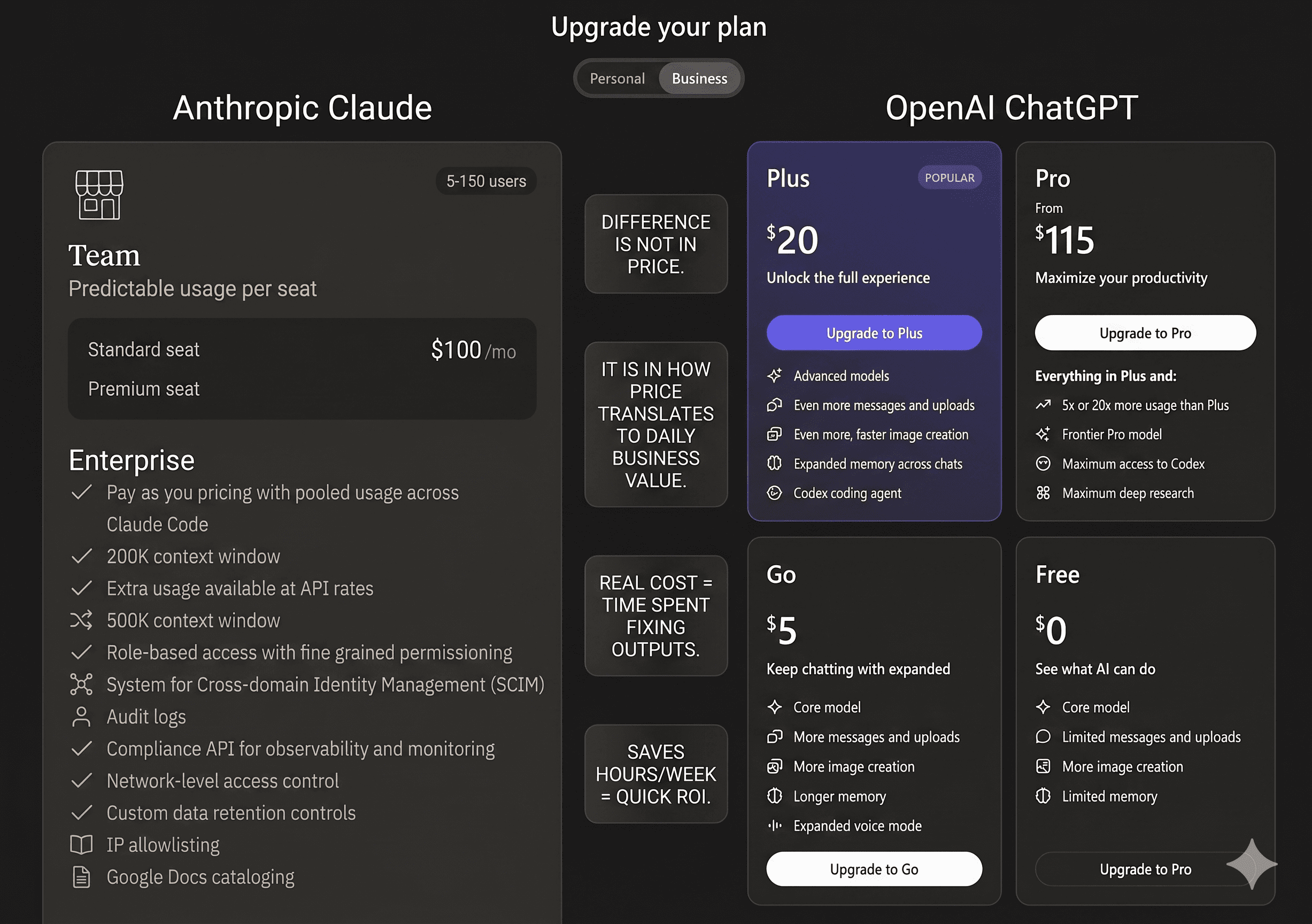
Claude vs ChatGPT pricing plans comparison 2026
At a glance, both OpenAI (ChatGPT) and Anthropic (Claude) are priced similarly, with core plans around $20 per month and higher tiers increasing with usage.
The difference is not in price. It is in how that cost translates into daily output.
ChatGPT is designed as a flexible, all-in-one tool. It supports content creation, planning, customer communication, and quick analysis, making it cost-efficient for teams that need speed and multi-task execution.
Claude focuses more on output quality. It produces structured, consistent responses, reducing time spent on editing and revision. This becomes valuable in workflows where clarity and accuracy matter.
The real cost is not the subscription. It is the time your team spends correcting weak output.
A tool that removes even a few hours of work each week quickly pays for itself.
Stop Chasing the “Best AI.” Choose the One That Moves Your Business
Most businesses compare Claude vs ChatGPT based on features, but the real difference shows up in daily work. ChatGPT helps teams move faster, handle multiple tasks, and keep execution flowing without delays. Claude focuses on clarity and structure, producing cleaner outputs that require less revision and improve decision quality.
The better choice depends on where your team is stuck. If speed is the problem, ChatGPT creates immediate impact. If quality and consistency are slowing you down, Claude delivers stronger results over time. In the end, the best AI is not the most advanced one. It is the one your team uses every day to remove friction and get better work done.
FAQ About Claude vs ChatGPT
What is the best AI model available right now for business use in 2026?
There is no single best AI model because it depends on your specific use case. In the Claude vs ChatGPT comparison, both ChatGPT-4.5/5 and Claude 3.5/4 are top-tier options. Most businesses choose based on speed, accuracy, and integration needs.
Which Claude model is best for coding tasks?
In the Claude vs ChatGPT debate, Claude 3.5 Sonnet is widely considered the strongest for coding. It handles debugging, reasoning, and long-context code analysis very well. Developers often use it for structured and complex programming tasks.
Is Claude AI better than ChatGPT for general use?
When comparing Claude vs ChatGPT, Claude performs better in long-form writing and deep reasoning. ChatGPT, however, is more versatile with tools, creativity, and integrations. The better choice depends on whether you prioritize depth or flexibility.
Is Claude better than ChatGPT for coding tasks?
In the Claude vs ChatGPT comparison for coding, Claude is excellent at understanding large codebases and maintaining context. ChatGPT is often preferred for real-world development workflows and faster iteration. Many professionals use both together for better results.
Which ChatGPT model is best for image generation and creative tasks?
In the Claude vs ChatGPT ecosystem, GPT-4o is the most effective ChatGPT model for image generation and creative work. It understands prompts more accurately and produces high-quality visual outputs. It is commonly used for design, marketing, and content creation.
Want to Go Beyond Just ChatGPT vs Claude?
The real advantage in 2026 is not just picking an AI tool. It is building the right AI system for your business.
If you are serious about using AI for growth, do not stop here. These guides will help you connect the dots:
- See how businesses are building smarter AI workflows in Custom GPT vs Chatbot Platform
- Discover which tools actually improve customer support and automation in Best AI Chatbot for Small Businesses
Because once you understand how these systems work together, choosing between AI tools becomes much easier and far more strategic.
LAUNCH THE AGENT. KEEP THE HUMAN CONTROL.
START FREE, CONNECT A CHANNEL, AND SHIP YOUR FIRST BOUNDBOT IN MINUTES.